
Can every cryptocurrency be mined?
No. Mining belongs to proof-of-work systems. Other networks use different mechanisms, and many tokens are issued by contracts rather than mined as a standalone network. Before downloading software or buying hardware, identify the exact chain and consensus mechanism.
The question 'which coin is best to mine?' also needs your equipment, electricity rate and objective. A learning experiment on a computer and a business buying dedicated hardware have different success criteria. This guide compares compatibility; it does not rank investments or promise current profits.
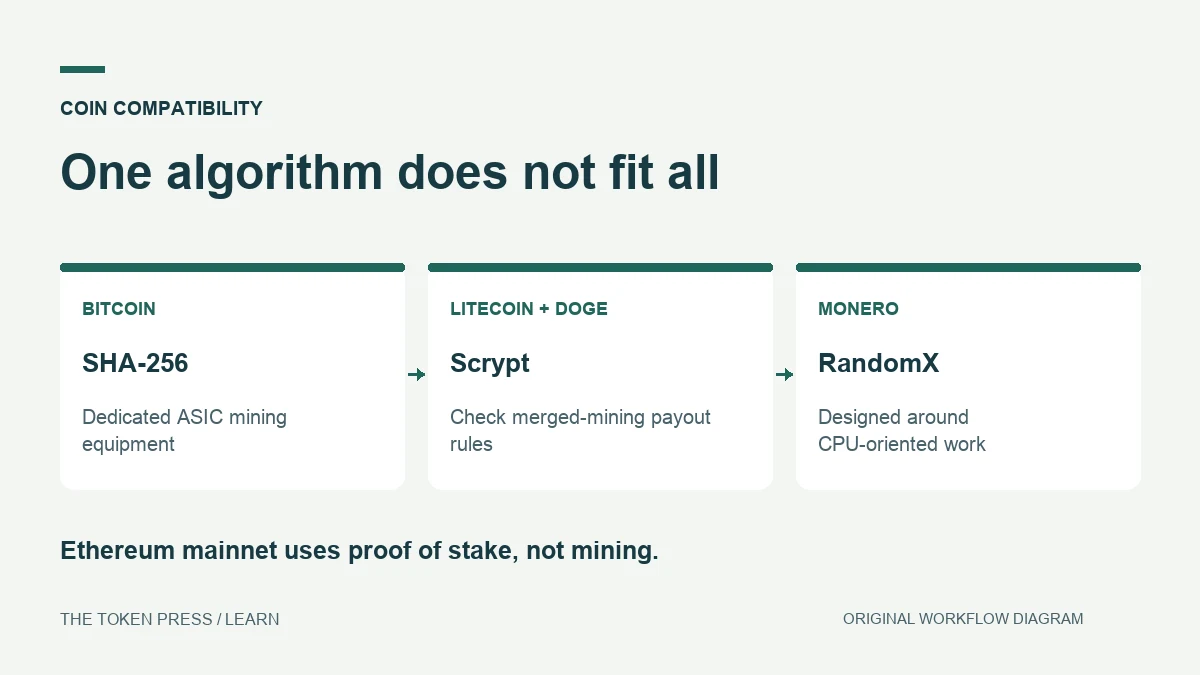
Bitcoin: SHA-256 and dedicated hardware
Bitcoin mining uses SHA-256 hashing and is dominated by specialized ASIC equipment. Read the exact algorithm and network support in a manufacturer's specifications. An ordinary computer can demonstrate the computation without becoming an economically competitive Bitcoin miner.
A useful buying question is therefore not 'does it mine crypto?' but 'what algorithm does this exact machine run, and which pool accepts that work?' Keep the answer separate from the currency in which a service displays your balance.
- Bitcoin developer guide: mining and shares ↗
- BITMAIN product catalogue: algorithms, power and cooling ↗
Litecoin and Dogecoin: understand Scrypt merged mining
Litecoin and Dogecoin use Scrypt proof of work. Dogecoin supports auxiliary proof of work, commonly called merged mining, which can allow compatible work to support multiple chains. Dogecoin's own mining guide describes Scrypt ASIC equipment and pool participation.
That does not mean every pool automatically credits every possible coin. Check what the pool mines, which rewards it distributes, whether it converts proceeds, the applicable fees and the withdrawal destinations. A Litecoin-labelled product and a Dogecoin payout can be compatible, but the payout rules need evidence.
A Bitcoin SHA-256 miner does not become a Scrypt miner by changing a wallet address. The hardware compatibility check comes before the pool configuration. Do not compare a Scrypt GH/s rating with a Bitcoin TH/s rating as if both represented the same work.
Monero: RandomX and CPU-oriented work
Monero uses RandomX, designed to favour general-purpose CPUs and discourage specialization. The project documents solo and pool options. CPU-oriented does not mean free electricity or automatic profit, and 'ASIC resistant' should not be read as a permanent guarantee that no specialized product will ever be marketed.
For a learning exercise, a computer you already own may remove the need for a new purchase, but it still consumes power and produces heat. Use only equipment you own or have explicit permission to operate. Avoid random binaries, and verify downloads using the project's published verification process.
When evaluating a dedicated product marketed for RandomX, compare independent operating evidence, the exact algorithm, efficiency and full cost. The marketing label by itself does not establish an advantage over a CPU.
Can you still mine Ethereum?
Ethereum mainnet moved to proof of stake in September 2022. Its official documentation says mining is no longer used to secure mainnet. A guide telling you to set up a GPU to mine current mainnet ETH is outdated.
A different proof-of-work chain, or a service converting another mined asset into ETH, is a different activity. Similar names and ticker symbols do not establish the same network, liquidity or risk. Staking ETH is also not GPU mining.
This is why source dates matter. Some older mining tutorials still mention Ethereum as a GPU example. Verify the network's current documentation before following any old equipment recommendation.
Practice: identify what is actually being mined
Consider three fictional offers. A offers a SHA-256 device with a Litecoin receiving address. B offers Scrypt work through a pool that documents Litecoin and Dogecoin reward handling. C offers a GPU service that pays ETH but says it mines another proof-of-work asset.
A has an algorithm mismatch for direct Litecoin mining. B is plausible at the compatibility level, but its fee and payout terms still need checking. C describes conversion into ETH, not Ethereum mainnet mining. None of these statements proves profitability.
For any new coin, repeat four checks: consensus mechanism, hashing algorithm, compatible equipment, and actual payout rules. Then calculate energy cost for the same operating period used in the revenue estimate.
- Name the chain, not just the payout ticker.
- Match the hashing algorithm to the hardware.
- Read direct, merged or converted payout rules.
- Check current project documentation rather than an old ranking list.
Sources & further reading
- Bitcoin developer guide: mining and shares
- BITMAIN product catalogue: algorithms, power and cooling
- Dogecoin: mining and Scrypt merged mining
- Monero: mining options and RandomX
- Monero: what RandomX is designed to do
- Ethereum: mining is no longer used on mainnet
Educational content. Examples are illustrative. Protocols, products and rules can change; consult the linked documentation for current details.