
What is crypto mining?
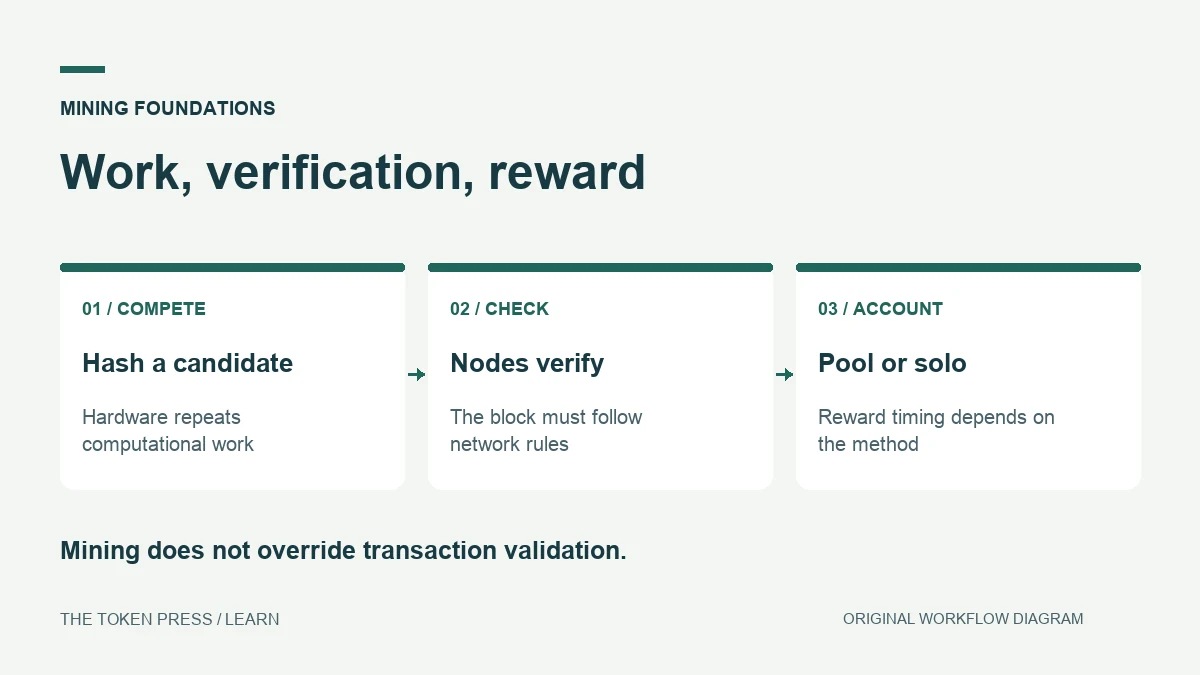
Crypto mining is the process used by proof-of-work networks to compete to add valid blocks. Bitcoin miners repeatedly hash candidate block headers, looking for a result below the network's target. Validating nodes independently check the resulting block. A miner cannot make an invalid payment legitimate just by spending electricity.
Mining is sometimes described as solving maths puzzles, but the useful distinction is between repeated computational attempts and ordinary transaction verification. A successful Bitcoin block can pay its producer a block subsidy plus transaction fees. That reward is not a guaranteed daily salary for every machine connected to the network.
Do you need to mine to use Bitcoin?
No. Receiving bitcoin, running a wallet, operating a validating node and operating a miner are different activities. A wallet manages signing authority; a node checks rules; a miner competes to produce blocks. An exchange account is another arrangement in which a provider manages assets and records your balance.
For example, a reader who only wants to verify a payment does not need to buy a mining machine. Start by identifying the job you want to do. Our wallet and transfer guides cover using assets; this guide covers evaluating a mining operation.
Solo mining or a pool: what changes?
A solo miner bears the uncertainty of finding a qualifying block. A pool coordinates work and accounts for contributors using shares: proofs meeting the pool's easier target. Most shares are not Bitcoin blocks. A dashboard showing accepted shares is evidence of submitted work, not proof that your machine personally earned a whole block reward.
Read the pool's payout method, fee, minimum withdrawal and rules for rejected work. For example, Braiins documents an FPPS calculation that includes a subsidy component and a network-fee component. A smoother payout method does not freeze coin prices, difficulty or the operator's ability to pay. Keep pool account security and withdrawal control separate from hardware performance.
How do you start mining? Use this order
Start with a budget on paper. Choose the network, establish the compatible algorithm and price the entire installation. Include power delivery, cooling, networking, repairs and the time needed to maintain it. A seller's machine-only price cannot answer whether a room is suitable or whether the operation covers its costs.
Only after that assessment should setup follow the exact manufacturer's manual. Prepare a receiving wallet, select and verify a pool, secure the device's local administration interface, and enter the pool's worker details. Do not enter a recovery phrase into a miner or a pool form. A receiving address is different from authority to spend.
- Confirm the network and hardware algorithm match.
- Have the electrical supply and cooling checked for the exact continuous load.
- Use manufacturer firmware and instructions for the precise model.
- Set a unique administration password and avoid exposing the management page to the public internet.
- Verify the payout address independently, then compare accepted work with the pool dashboard.
- Record energy used and actual payouts before increasing the scale.
Can you mine Bitcoin on a phone or laptop?
Software can demonstrate hashing on general-purpose computers, but that does not make a phone or laptop competitive with dedicated Bitcoin hardware. An app displaying a rising token balance may be awarding points, selling a hosted contract or converting other earnings. Ask what chain is actually being mined, where the work is submitted and how withdrawals are verified.
Cloud mining also changes the question: you are evaluating a contract and its counterparty, rather than controlling a physical device. Identify maintenance deductions, cancellation terms, evidence of delivered work and withdrawal restrictions. A promised fixed return is not a feature of Bitcoin's consensus rules.
Practice: audit a fictional mining offer
Suppose an offer promises a $12 daily payout from a 3 kW machine but says nothing about fees, downtime or electricity. At an illustrative $0.15 per kWh and 24 hours of operation, energy costs $10.80 a day. Only $1.20 remains before every other expense. This is an arithmetic exercise, not a live revenue estimate.
The useful answer is not simply profitable or unprofitable. The offer is incomplete: you still need evidence for the revenue assumption, the coin and algorithm, the accepted hashrate, the payout policy and the total installation cost. Test a lower-revenue case before treating a dashboard projection as income.
Sources & further reading
- Bitcoin developer guide: mining and shares
- Bitcoin: mining questions and economics
- Braiins: rewards, fees and payout rules
- BITMAIN: model-specific S19/S19 Pro setup instructions
Educational content. Examples are illustrative. Protocols, products and rules can change; consult the linked documentation for current details.