
How much electricity does crypto mining use?
There is no single mining electricity bill. It depends on the equipment's wall power, hours running, cooling and the tariff charged at the site. Power in watts and energy in kilowatt-hours are different quantities. A 3,000 W load is 3 kW; running it for one hour consumes 3 kWh if the load stays constant.
The basic calculation is energy in kWh = watts ÷ 1,000 × running hours. Multiply that energy by the price per kWh. Use the actual tariff and bill structure; examples here are hypothetical and do not represent an Indian, UAE or U.S. utility quote.
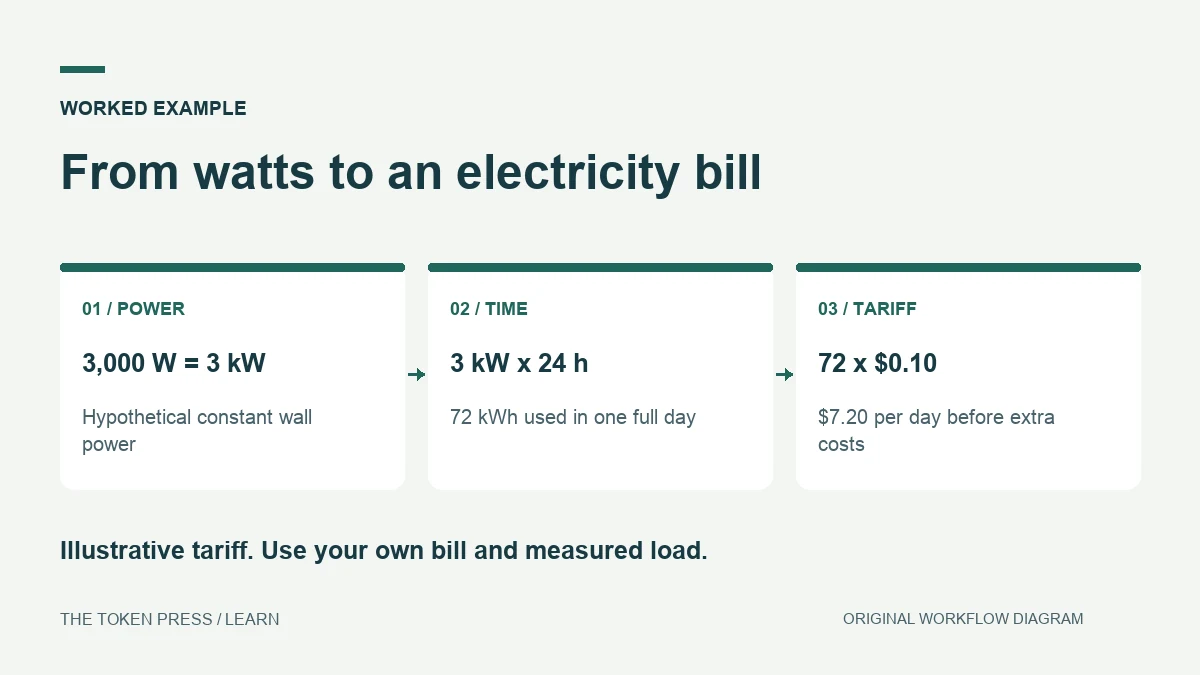
Worked example: a 3,000 W miner running all day
Assume 3,000 W at the wall and 24 hours each day. Daily consumption is 3 × 24 = 72 kWh. Over 30 identical days, it is 2,160 kWh. This calculation excludes separate cooling and other equipment; if a measured site total already includes them, do not add them twice.
At an illustrative ₹8 per kWh, electricity is ₹576 per day and ₹17,280 per 30 days. At an illustrative AED 0.30 per kWh, it is AED 21.60 and AED 648. At an illustrative US$0.10 per kWh, it is US$7.20 and US$216. These are independent tariff examples, not currency conversions.
If the machine runs for only 20 hours a day, its consumption is 60 kWh before extra equipment. Do not reduce the electricity input for downtime while leaving estimated mining revenue at a full 24 hours. Both sides of the forecast need the same operating period.
Add cooling, tariff bands and charges correctly
Suppose separate ventilation and cooling average another 500 W during those 24 hours. The combined 3.5 kW load uses 84 kWh a day, or 2,520 kWh in 30 days. At the hypothetical ₹8 rate, the combined bill is ₹20,160: ₹2,880 more than the machine-only example.
If electricity has time-of-use pricing, split the hours into tariff periods and add their costs. If usage moves into a higher tariff band, use the incremental cost caused by the miner rather than an old household average. Add applicable fuel adjustments, demand charges, taxes and service charges according to the bill.
A consumer plug meter may be unsuitable for a large continuous load. Use correctly rated metering installed or selected by a qualified professional. For changing loads, a measured energy total over a representative period is more useful than a single instantaneous watt reading.
Revenue minus electricity is not full profit
Build the worksheet in layers: gross coin revenue, pool deductions, electricity, hosting or cooling not already counted, maintenance, and the equipment investment. Keep a column for coin units and a separate one for conversion into your expense currency. A coin price increase is not the same as improved energy efficiency.
Consider a fictional operation earning $10 a day before a 2% pool fee. Net revenue is $9.80. Subtract $7.20 electricity and $1.00 of other operating costs to get $1.60 daily operating surplus. That figure is before tax, financing and recovery of the machine's purchase and installation cost.
If its initial cost were $2,000, dividing by $1.60 gives 1,250 days of simple payback at frozen inputs. That is arithmetic, not a realistic promise: difficulty, fees, price, hardware condition and operating costs can change during that period.
Calculate the break-even electricity tariff
For the same fictional operation, the amount available for electricity is $9.80 − $1.00 = $8.80 per day. Divide by 72 kWh to get about $0.1222 per kWh. Above that rate, the operation loses money on the stated operating assumptions, before recovering its initial cost.
Now reduce gross revenue by 25%, to $7.50. After the same 2% fee and $1 other cost, only $6.35 remains for power. The operating break-even tariff falls to about $0.0882 per kWh. At $0.10 electricity, the result is a $0.85 daily operating loss.
This sensitivity test is more informative than a single green profitability number. Make another scenario for reduced uptime and another for repair costs. Do not count a speculative resale value as guaranteed cash.
A five-minute worksheet you can reuse
Write down the observation date, model, algorithm, measured watts, operating hours, tariff, pool terms and evidence behind revenue. Mark every assumed value. Recalculate when a major input changes, and compare forecasts with actual payouts and metered consumption.
For a no-purchase exercise, replace the example's 3,000 W with 2,400 W, keep 24 hours and use ₹8 per kWh. The answer is 57.6 kWh and ₹460.80 a day, or ₹13,824 over 30 days before extras. Changing the hardware input also requires a new revenue estimate; it is not free efficiency.
- Keep currency, time period and energy units consistent.
- Separate measured data from manufacturer ratings and assumptions.
- Count cooling exactly once.
- Include pool fees and unrecovered setup cost.
- Test a lower-revenue case before any purchase decision.
Sources & further reading
- U.S. Department of Energy: power, time and kilowatt-hours
- Braiins: rewards, fees and payout rules
- Braiins: nominal and effective hashrate
Educational content. Examples are illustrative. Protocols, products and rules can change; consult the linked documentation for current details.