
Return needs a definition
A return compares an outcome with a starting value over a stated period. Nominal return uses money amounts; real return accounts for changes in purchasing power. Gross returns can differ from results after fees and other costs.
Volatility measures variation under a chosen method. It does not capture every risk, including inability to withdraw, fraud, custody failure or a market with no willing buyer.
A compounding example
If an illustrative balance of $100 grew by 10% in each of two periods with no costs, it would become $110 and then $121. The second period’s increase applies to the larger balance. This arithmetic does not predict any product’s return.
Losses work differently from equal-sized percentage gains: a 50% fall from $100 leaves $50, which then requires a 100% gain to return to $100. Always use the correct starting base.
Separate product claims
APR and APY depend on how rates and compounding are described. A displayed rate may change, and reinvestment assumptions may not match what users can actually do. Read the product’s terms and calculation method.
Diversification changes exposure across risks but cannot eliminate losses. Before comparing products, write down their time horizon, access restrictions, fees, custody and source of return. This guide explains concepts; it does not select investments or determine an individual’s financial suitability.
A compounding example with explicit assumptions
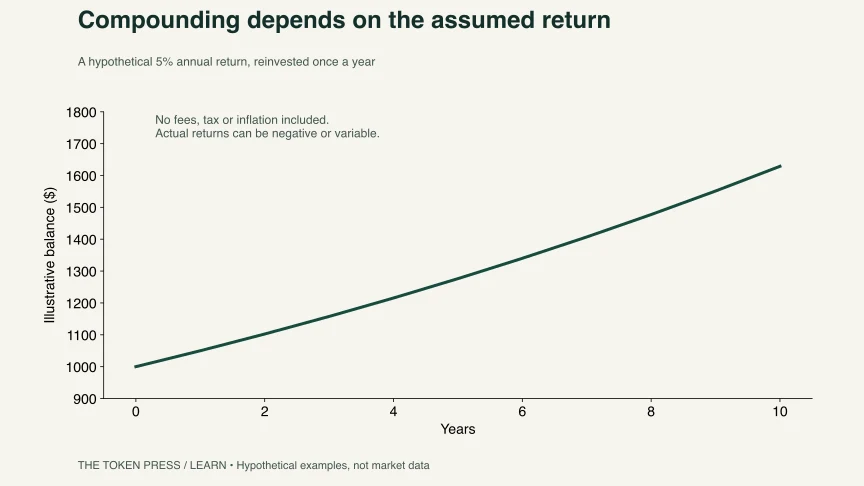
At a constant hypothetical 5% annual return reinvested once per year, $1,000 becomes $1,050 after one year and $1,102.50 after two. The second year’s $52.50 includes a return on the first year’s gain. This example assumes the return occurs, stays constant and is reinvested; it excludes costs, tax and inflation.
Actual returns can be negative and variable. A quoted APR and an APY may use different compounding assumptions. Read the calculation period, rate changes and fees before comparing them. A calculator illustrates assumptions; it cannot make those assumptions true.
Losses and recovery are asymmetric
A fall from $100 to $50 is a 50% loss. Recovering from $50 to $100 requires a 100% gain. A 50% rise after that loss only reaches $75. This arithmetic explains why averaging percentage returns can conceal the effect of losses on an actual balance.
Diversification can spread some exposures but does not remove all risk. Several tokens may depend on the same exchange, collateral, bridge or broad market conditions. Listing many tickers is not the same as identifying independent sources of risk. The appropriate choice for an individual depends on circumstances this educational example does not assess.
Sources & further reading
Educational content. Examples are illustrative. Protocols, products and rules can change; consult the linked documentation for current details.