
What is an Antminer?
ANTMINER is BITMAIN's mining-hardware brand. It is not a coin or a synonym for all mining equipment. An ASIC is an application-specific integrated circuit: hardware specialized for a particular kind of computation. In a mining machine, the relevant algorithm determines which proof-of-work networks it can serve.
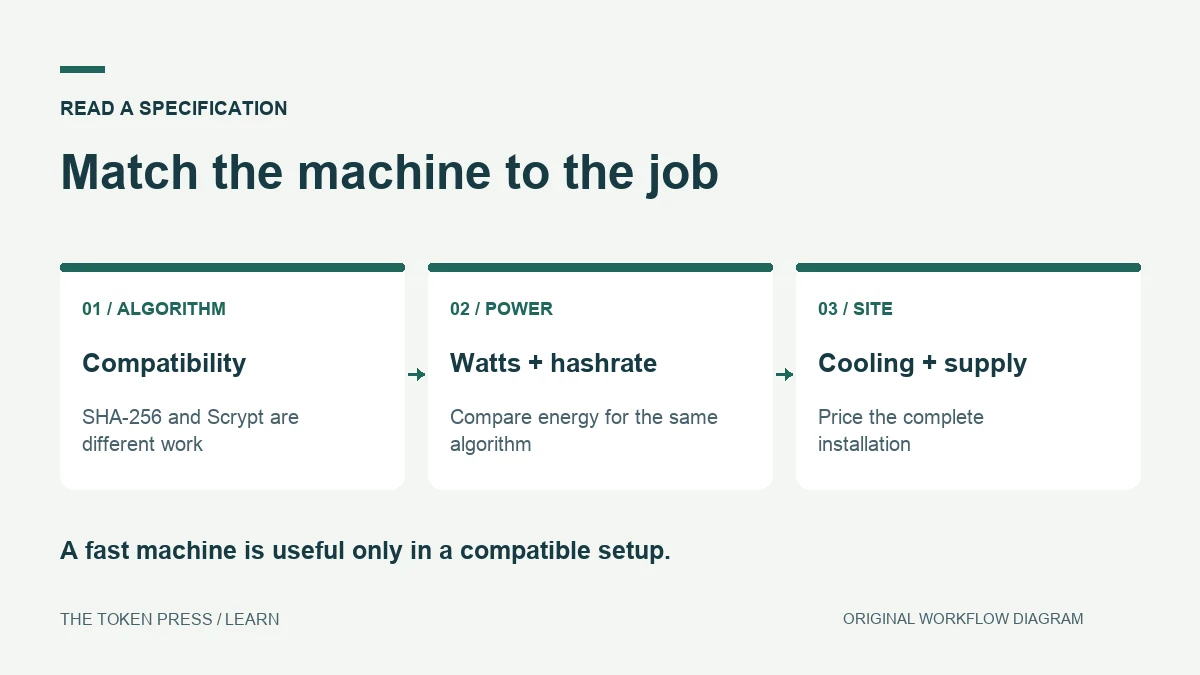
A question such as 'which Antminer should I buy?' is missing essential information. First specify the network, electricity tariff, installation constraints and budget. Then compare exact model numbers and variants. Similar names do not establish the same power requirements or cooling system.
CPUs and GPUs are programmable processors used for many tasks. A mining ASIC is specialized more narrowly. Whether a general-purpose processor is useful for mining depends on the algorithm; the fact that a gaming computer has a powerful GPU does not establish suitable Bitcoin mining economics.
Can one mining machine mine every coin?
No. A Bitcoin SHA-256 ASIC is not interchangeable with a Scrypt machine used for Litecoin and Dogecoin mining. Monero's RandomX has a different design again. A payout in a particular coin also does not prove that the machine directly mines that coin: a service may convert the proceeds.
Treat compatibility as a pass-or-fail check before comparing speed. Comparing terahashes for one algorithm with megahashes for another does not rank their profitability. The underlying work and reward markets differ.
How do hashrate, watts and J/TH fit together?
Hashrate measures attempts per second. Power describes the rate of electricity consumption. Efficiency expresses energy per unit of hashing work; for Bitcoin hardware it is often shown as joules per terahash, or J/TH. Lower energy per hash can reduce operating cost, but does not determine purchase price or total return.
As a dated manufacturer-specification example, BITMAIN's catalogue lists an S21 Pro variant at 234 TH/s, 3,510 W and 15 J/TH. The arithmetic is 3,510 ÷ 234 = 15. These are catalogue specifications checked on October 22, 2026, not a measured result from our own machine and not a recommendation to buy that model.
For an independent comparison, imagine two devices producing the same 200 TH/s. Device A uses 3,000 W; B uses 4,000 W. Their efficiencies are 15 and 20 J/TH. At $0.10 per kWh, B's extra 1 kW costs $2.40 per 24-hour day, or $72 over 30 full days. A lower purchase price must be assessed against that continuing difference.
Why does pool hashrate differ from the label?
A catalogue rating is not the same measurement as a pool's estimate from submitted shares. Braiins distinguishes nominal hashrate from effective hashrate, which varies with the work the pool receives and the observation window. A short dashboard interval can fluctuate even when the miner is functioning.
For your own comparison sheet, record the averaging period, temperatures, uptime, rejected shares and measured wall power together. A screenshot with a high hashrate but no time window is weak purchase evidence. Investigate persistent differences rather than adjusting forecasts to the best five minutes.
Air, hydro and immersion cooling are different installations
BITMAIN lists air-cooled, hydro-cooled and immersion products. Those labels describe different systems, not interchangeable accessories. A machine that requires a liquid-cooling installation should not be priced as if a desk fan makes it ready to use. Ask for the model manual and a complete site quote.
A high continuous electrical load, heat and noise can make a residential location unsuitable. Have a qualified electrician check supply, protection, connectors and continuous-load requirements for the actual equipment. Do not infer electrical compatibility from a plug adapter or attempt improvised wiring.
For used hardware, request a dated operating report, serial/model identification, repair history, firmware information, ownership evidence and written return terms. Verify who provides the warranty and whether it transfers. These checks do not guarantee a good purchase; they reveal what a cheap listing leaves unresolved.
Practice: build a comparison before choosing a model
Create two columns for candidate machines and one for evidence. Fill algorithm, nominal hashrate, wall power, efficiency, cooling, input requirements, landed price, warranty and expected downtime. Leave a cell blank if you cannot substantiate it; do not replace it with the seller's revenue promise.
For the hypothetical 200 TH/s pair, calculate whether a $400 saving on B compensates for $72 of extra electricity every 30 days. At unchanged inputs, that saving is consumed in about 5.56 months. This is a cost comparison, not a payback forecast: coin revenue, repairs and resale value are still unknown.
Sources & further reading
- BITMAIN: ANTMINER manufacturer and product families
- BITMAIN product catalogue: algorithms, power and cooling
- Braiins: nominal and effective hashrate
- BITMAIN: model-specific S19/S19 Pro setup instructions
Educational content. Examples are illustrative. Protocols, products and rules can change; consult the linked documentation for current details.