
Why stake exists
In proof-of-stake systems, validators commit value and participate in checking or proposing blocks. Rewards and penalties support the protocol’s rules. The exact duties, deposit requirements and penalties depend on the network.
Staking is not synonymous with every product advertised as earning yield. A lending account, exchange promotion and native validator arrangement can have very different underlying risks.
Choose the correct comparison
Solo operation involves running and maintaining validator software. A service may operate infrastructure for a user. Pooled and liquid-staking arrangements can lower participation barriers while adding smart-contract, operator or token-redemption dependencies.
Slashing is a protocol penalty for specified validator misconduct; it is distinct from every ordinary downtime penalty. Liquid-staking tokens may trade away from the value of the underlying claim, particularly when withdrawals or liquidity are constrained.
Ask where returns come from
Separate protocol rewards from extra token incentives and any additional borrowing or trading strategy. Compare fees and the conditions under which funds become withdrawable. A quoted annual percentage is not a guaranteed future outcome.
As a learning exercise, draw the route from a depositor to the validator. List every service, contract and receipt token along the route. Each added component deserves its own explanation. Do not assume that a familiar network name removes the risks of an intermediary product.
Token rewards and purchasing power can move differently
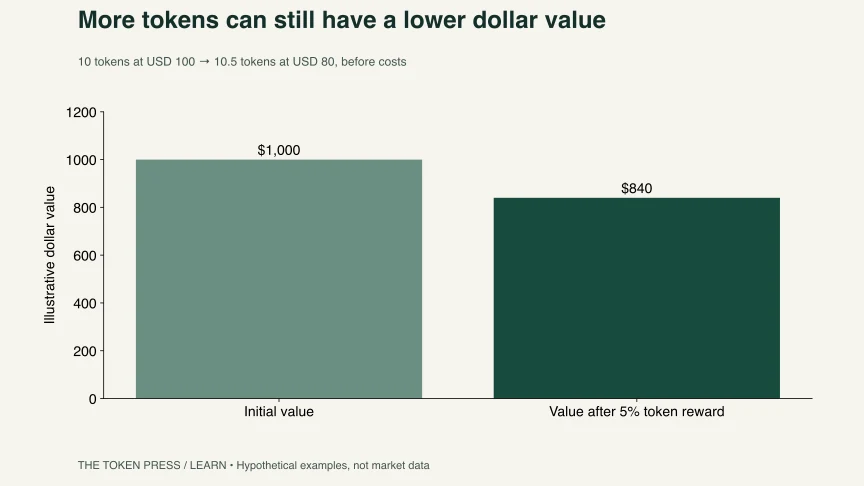
Assume a hypothetical holding of 10 tokens earns 0.5 tokens over a year before costs. That is a 5% token-denominated reward. If the unit price falls from $100 to $80, the final 10.5 tokens are worth $840, compared with $1,000 initially. A positive token reward did not produce a positive dollar return.
This simplified illustration excludes fees, penalties, tax, changing reward rates and withdrawal timing. A displayed annual rate is not a promise that the same rate will persist. Compare the unit in which rewards are quoted with the unit in which you measure outcomes.
Separate validator, service and liquid-token risks
Running a validator involves protocol duties and operational responsibility. Delegating through a service adds dependence on that service’s setup. Receiving a liquid staking token can add contract and market risks, including a market price that differs from the value a redemption process might eventually deliver.
Check withdrawal rules, fees, control of keys and who bears penalties. Slashing and inactivity penalties have specific protocol meanings and should not be used interchangeably. Documentation for one network does not establish the rules of another.
Sources & further reading
Educational content. Examples are illustrative. Protocols, products and rules can change; consult the linked documentation for current details.