
How lending applications work
Decentralized finance uses blockchain applications for activities such as exchange and lending. In a collateralized lending market, a borrower supplies assets and borrows against their value under the application’s rules. Smart contracts implement accounting and transaction conditions.
The application still depends on code, price inputs, governance and the networks supporting it. The absence of a traditional branch office does not mean the absence of operational dependencies.
Why liquidation occurs
A lending protocol requires a buffer between collateral value and debt. If prices move or interest accumulates enough to breach the rules, a liquidation mechanism can sell or transfer collateral to reduce the debt.
For a simplified illustration, $150 of collateral against $100 of debt begins with a larger buffer than $110 against $100. The actual liquidation threshold is protocol- and asset-specific; this example is not a usable borrowing limit.
Read a position carefully
Check the collateral asset, borrowed asset, interest-rate model, oracle, liquidation threshold and fees. A displayed yield can combine lending interest with temporary incentive tokens.
Using a stablecoin does not remove contract risk or the possibility of a depeg. Combining multiple protocols creates dependencies between them. Before considering a transaction, explain what would happen if the collateral fell sharply, the oracle stopped updating or the application’s interface became unavailable.
A simplified collateral example
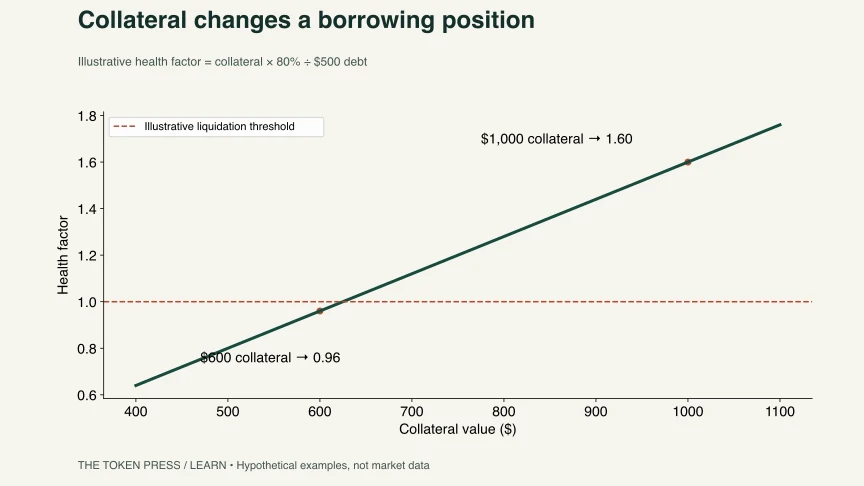
Suppose collateral is valued at $1,000 and a hypothetical protocol applies an 80% liquidation threshold. A $500 debt gives a simplified health factor of $1,000 × 0.80 ÷ $500 = 1.6. If collateral value drops to $600 with unchanged debt, the factor becomes 0.96. Under this illustrative rule, the position has crossed below 1 and can become liquidatable.
Real positions can involve several assets, changing interest, different thresholds and special modes. The example teaches the relationship between collateral and debt; it is not a safe borrowing limit or a guarantee about a specific protocol. Use the protocol’s current parameters to analyze an actual position.
Why a displayed buffer can shrink
The collateral price can fall, the borrowed asset can rise relative to it, and interest can increase the debt. Liquidation fees or bonuses can further reduce what remains. An interface warning is useful but cannot guarantee that a user will have time to act during congestion or rapid market movement.
Check which oracle supplies prices, when observations update and what happens during an outage. A successful smart-contract audit does not remove market, oracle or governance risk. Depositing, borrowing and supplying a volatile collateral asset are different actions with different loss paths.
Solve the threshold, then stress the debt
In the earlier hypothetical position, debt is $500 and the liquidation threshold is 80%. Solving collateral value × 0.80 ÷ $500 = 1 gives $625. Starting from $1,000, that is a 37.5% decline to the simplified boundary. It is not a guaranteed execution price or a safe loss buffer.
Now let accrued interest increase the debt to $525. The same boundary becomes $656.25. If collateral is worth $650, the health factor is $650 × 0.80 ÷ $525, or about 0.9905. The position can cross the rule without the collateral reaching the original $625 estimate.
Aave documents a health-factor model using collateral value, the weighted liquidation threshold and borrowing value. Actual rules depend on collateral, market configuration, position size and mode. Maximum loan-to-value for opening a borrow is a different parameter from the liquidation threshold. Never substitute one for the other or reuse a threshold from another market.
A practical position record needs the chain and market, assets and units, oracle prices and timestamps, debt including accrued interest, collateral eligibility, liquidation thresholds, applicable bonuses and any special mode. Recalculate from current inputs. An alert, planned repayment or available balance elsewhere does not guarantee that a transaction will execute before a permissionless liquidation.
Sources & further reading
Educational content. Examples are illustrative. Protocols, products and rules can change; consult the linked documentation for current details.