
What does SI mean in AI discussions?
In this guide, SI means superintelligence, often written as ASI for artificial superintelligence. The abbreviation can mean other things elsewhere, so read the surrounding context. It is a capability concept, not a single app, model subscription or product that automatically comes “after ChatGPT.”
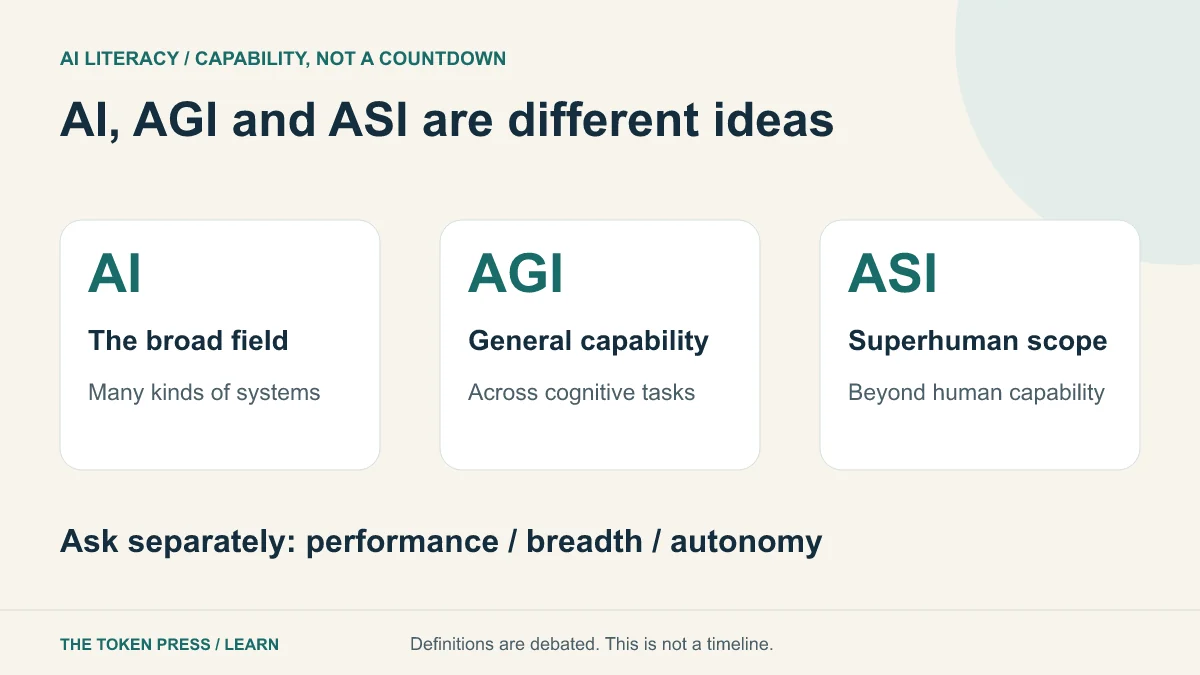
AI is the broad field. AGI refers to general capabilities across a wide range of cognitive tasks, with disagreement about the exact threshold. ASI describes capabilities exceeding human performance broadly; authors differ about the comparison group and how far beyond humans a system would need to go.
A useful research framework from Google DeepMind separates performance, breadth and autonomy. Those distinctions help explain why a system can be excellent at one task without establishing general intelligence, and why giving a system more tools is not itself proof of greater underlying capability.
Three dimensions that headlines often mix together
Performance asks how well a system does a task. Breadth asks how many different kinds of task it can handle, including unfamiliar ones. Autonomy asks how much it can do without intervention. A strong answer on one dimension does not automatically settle the other two.
Consider a fictional app that classifies invoices accurately but needs a person to fix every new format. Compare it with an assistant that attempts many office tasks but makes frequent factual mistakes. One has a narrow strength, the other broader coverage. Calling either “superintelligent” adds little unless the claim specifies tasks, reliability and comparison conditions.
Consciousness is a different question. A system’s fluent use of first-person language or success on a benchmark does not, by itself, establish subjective experience. Keep capability claims separate from claims about what a system feels.
Why people are discussing superintelligence
Researchers are studying possible paths beyond human-level general systems, not merely improving a chatbot’s next response. The 2026 report From AGI to ASI examines several possibilities, including scaling, new approaches, recursive improvement and large collections of agents. It also discusses bottlenecks and uncertainty.
That is a research agenda, not evidence that all those paths work or that a particular arrival date is guaranteed. The report’s publication is a concrete reason the subject appears in discussion; it does not establish search demand or prove that ASI has been achieved.
The topic matters because more capable systems could change how research and organizations operate, while raising questions about reliability, oversight and who controls consequential actions. The useful response is to examine evidence and deployment conditions rather than treating every impressive demo as a milestone announcement.
Why one benchmark score cannot settle the question
Google DeepMind’s March 2026 cognitive framework proposed evaluating a broad set of abilities and comparing systems with human baselines. It describes measurement gaps rather than offering a universal certificate of AGI. A score is meaningful only with the task definition, test conditions and comparison group.
Ask whether a reported result used previously unseen questions, external tools, repeated attempts or substantial human assistance. Check what was counted as success and which failures were excluded. A model solving a curated puzzle set does not automatically show that it can manage a business or perform reliable research across domains.
Read an announcement in four layers
First identify the actual artifact: a research paper, benchmark result, limited demo or product release. Next identify availability: public, invitation-only, internal or merely proposed. Then inspect the evidence for the specific capability. Finally consider whether the result applies to your own task.
An announcement may be accurate yet narrower than its headline sounds. “Can generate candidate code” and “can safely operate a production service unattended” are different claims. Likewise, a provider’s forecast is a forecast even when made by a respected researcher.
- Which version or system was evaluated, and when?
- What tasks and comparison group define the claim?
- Were tools, retries, extra compute or human intervention allowed?
- Are methods, limitations and failure cases available?
- Can independent readers reproduce the result?
- Does the evidence describe a current capability or a proposed future?
Five-minute exercise: classify three claims
Claim A: “A model solved 92 of 100 tasks in a published evaluation.” This is a bounded performance claim. You still need the method and baseline; it does not establish ASI.
Claim B: “A lab expects broadly superhuman systems in five years.” This is a prediction. Record the forecast date and assumptions rather than restating the deadline as a fact.
Claim C: “An agent can purchase API data within a spending cap.” This describes a workflow and permissions. It may be useful without resolving whether the model is AGI. Its payment controls deserve practical tests independent of the intelligence label.
What a builder should do today
Choose tools by demonstrated usefulness on your workload. Keep source material, test failures, control permissions and monitor costs. A small business needs a reliable form, correct records and recoverable changes regardless of which frontier label is fashionable.
You do not need to wait for an agreed AGI definition to learn useful skills. Start with the linked building guides, save your evaluation examples and revisit model choices when evidence changes. There is no established timetable in this guide for AGI or ASI, and no claim that a consumer product is certified superintelligent.
Sources & further reading
- Google DeepMind research: Levels of AGI
- Genewein and colleagues: From AGI to ASI, revised August 30, 2026
- Google DeepMind: measuring progress toward AGI
Educational content. Examples are illustrative. Protocols, products and rules can change; consult the linked documentation for current details.