
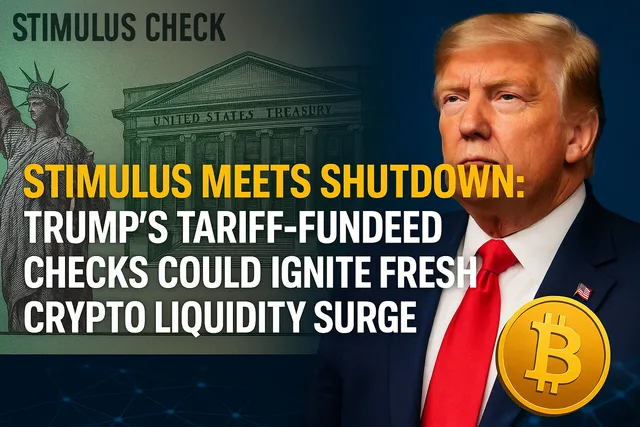
A new round of stimulus checks may be on the horizon in the United States — this time funded by import tariff revenue — and analysts say it could provide a powerful boost to liquidity in both traditional and crypto markets, especially as investors flock to safe-haven assets amid a prolonged government shutdown.
U.S. President Donald Trump told One America News Network on Thursday that he is considering issuing direct payments of $1,000 to $2,000 per individual, financed through revenue generated from import tariffs.
Related reporting: Breez Launches ‘Time2Build’ to Accelerate Real-World Bitcoin Lightning Network Integration
Trump said that while the tariff income is only “starting to kick in,” it could eventually bring in “over a trillion dollars a year.”
According to the U.S. Treasury Department, tariff collections have already reached $214 billion in 2025, providing the government with a new funding source amid ballooning national debt, which now stands at over $37 trillion.
Trump described the plan as a “dividend” for the American people, noting that part of the revenue would also be used to pay down federal debt. However, the proposal will require congressional approval — a challenge given the current seven-day-old government shutdown and ongoing partisan gridlock in Washington.
Stimulus Checks Could Act as a Liquidity Catalyst
Market analysts say that if implemented, tariff-funded stimulus payments could act as a major liquidity injection for risk assets — similar to the dynamic seen during the 2020 pandemic stimulus cycle.
Analysts from Bitfinex told Cointelegraph that additional liquidity from such payments could “serve as a catalyst for renewed market activity,” particularly in the crypto sector, which historically benefits from periods of high retail cash flow.
“A similar dynamic played out following the COVID-era stimulus, which injected substantial liquidity into both traditional and digital markets, contributing to Bitcoin’s explosive rally at the time,” the analysts said in a note.
Following the $2 trillion stimulus package signed in March 2020, Bitcoin surged from around $6,000 to $69,000 by late 2021 — an increase of more than 1,000%. Analysts credit a mix of retail inflows, institutional adoption, and Federal Reserve quantitative easing (QE) for fueling that rally.
QE, a monetary policy in which the central bank purchases bonds to increase money supply and lower interest rates, was expanded aggressively during that period, with the Fed adding $4 trillion in liquidity to stabilize financial markets.
Shutdown Adds to Economic Uncertainty
The renewed talk of stimulus comes as the U.S. faces a partial government shutdown that has stretched into its second week. Lawmakers have repeatedly failed to agree on a funding bill, with negotiations stalling for the fifth time on Monday.
BTC/USD, one-week chart, 2020–2021. Source: Cointelegraph/TradingView
The Senate is scheduled to reconvene later on Tuesday, but political analysts see little chance of an immediate resolution. On prediction platform Polymarket, traders currently estimate a 68% probability that the shutdown will continue until at least October 15.
As political uncertainty rises, demand for safe-haven assets like gold and Bitcoin (BTC) has surged. Bitcoin recently reclaimed the $121,000 level, while gold reached new all-time highs above $3,900 per ounce.
Some analysts say that a combination of fiscal stimulus and weakening confidence in the U.S. dollar could once again drive investors toward decentralized and deflationary assets such as Bitcoin.
Odds of the government shutdown ending by Oct. 15. Source: Polymarket
“If stimulus checks are distributed amid a weakening dollar and fiscal pressure, we could see a repeat of the 2020-style liquidity wave — but this time, with a stronger institutional foundation for crypto,” said one fund manager based in Dubai.