
Market cap vs volume vs liquidity: the short answer
Market capitalization estimates the value of circulating supply at a reference price. Trading volume measures transactions over a specified period. Liquidity describes the ability to execute a particular trade without a large price change. These answer different questions: estimated size, recent activity and execution conditions.
A token can have a large quoted market cap but little available depth on the venue you use. A market can also report high volume while offering poor execution for a large order. None of these figures, by itself, measures cash backing, future returns or the quality of a project.
Worked example: why a $0.10 token is not necessarily cheaper
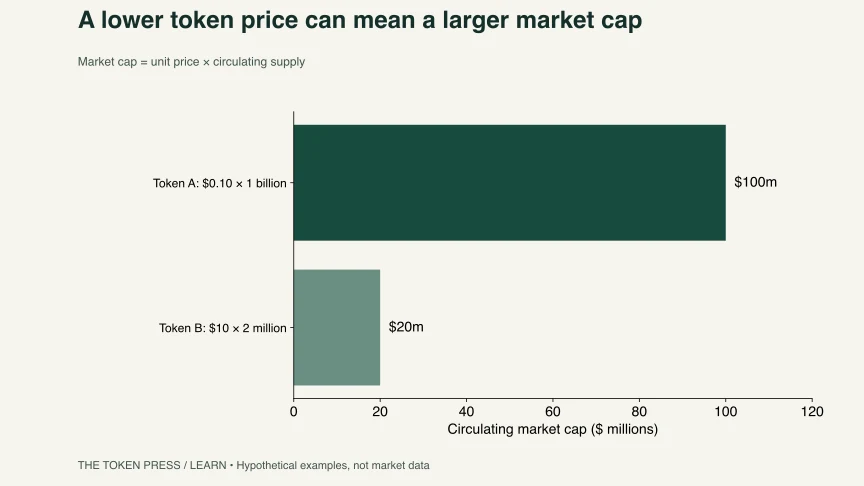
Fictional Token A trades at $0.10 with 1 billion tokens circulating, giving a circulating market cap of $100 million. Token B trades at $10 with 2 million circulating, giving $20 million. Token A has the lower unit price and the larger capitalization. Unit prices cannot be compared meaningfully without the supply.
If A’s stated maximum supply is 5 billion, multiplying that number by the same $0.10 gives a hypothetical fully diluted valuation of $500 million. This calculation holds price constant for comparison. It does not predict the price when additional tokens circulate, and a stated maximum must be checked against the token’s actual rules.
A liquidity example: the quoted price is not the whole trade
Suppose an order book offers 100 tokens at $10 and the next 100 at $11. Buying 200 consumes both levels and costs $2,100 before fees, averaging $10.50. Multiplying the first quote by 200 would understate the cost by $100. Other traders can change the book before execution, so a snapshot remains only a snapshot.
The difference between the best buy and sell quotes is the spread. Depth is the amount available at successive prices. Price impact is the effect of the trade on execution prices; slippage can also include movement between the expected and actual execution. Read a venue’s definitions because interfaces may group these costs differently.
A checklist for comparing market-data pages
Use the same timestamp, quote currency, pair and period. Check which venues contribute to the price and volume and whether the provider excludes unreliable observations. Determine how circulating supply is estimated, what is excluded, and when it was updated. Two providers can disagree because they use different inputs or methods.
For a reported volume increase, compare like periods and examine the underlying venues. Trading activity is not automatically new money entering an asset: the same tokens can trade repeatedly. Likewise, a change in capitalization is not the amount deposited into a project. Multiplying a changed reference price by all circulating units can produce a large change without that amount of money changing hands.
Read the methodology
Check the timestamp, quote currency, circulating-supply assumptions and exchange coverage of any data page. Reported volume can be distorted, and thin markets can produce misleading last prices.
Trending searches indicate attention, while gainers and losers describe changes over a defined interval. Neither is a measure of fundamental quality. Our market pages identify the data provider and scope so readers can interpret the numbers rather than treating a ranking as a recommendation.
Sources & further reading
Educational content. Examples are illustrative. Protocols, products and rules can change; consult the linked documentation for current details.