
What an exchange does
An exchange provides a place for trading. In a spot market, participants exchange the asset or a custodial claim to it. A derivative is a contract linked to an underlying value; owning a futures position does not by itself mean receiving the underlying token.
A listing announcement can concern spot trading, derivatives, pre-market access or an additional quote currency. These are different events. Our New Listings page focuses on verified new spot listings.
Market and limit orders
A market order seeks immediate execution against available liquidity. Its final average price may differ from the last displayed trade. A limit order sets the worst acceptable price but may remain unfilled if no matching order becomes available.
For example, an illustrative order to buy two units at a limit of $10 each cannot assume that both units will be available at that price. A partial fill leaves the remainder subject to the order’s instructions.
Costs and checks
Compare the spread, trading fees, withdrawal fees and supported networks. A venue’s reported volume does not describe every pair’s liquidity. Regional availability, custody arrangements and service terms also matter.
Practice reading an order book before using complex order instructions. Identify the highest bid, lowest ask and the amount available at each price. A top-ten ranking is a way to define our coverage universe, not a guarantee that an exchange or a newly listed asset is safe.
How a market order walks an order book
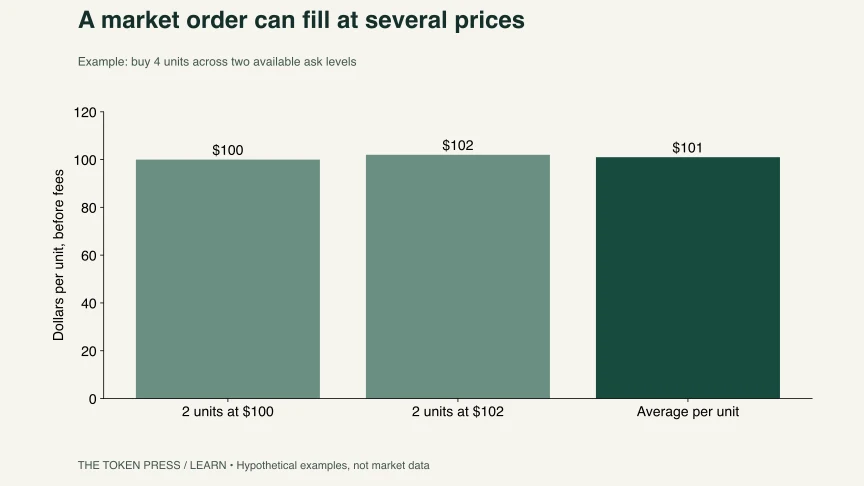
Imagine sell offers for 2 units at $100 and 3 units at $102. A market order for 4 units could fill 2 at each price, for $404 before fees: an average of $101. The visible $100 quote was not a promise to sell the full amount at that price. This simplified example excludes other orders arriving or cancelling.
A limit buy at $100 sets a maximum purchase price, but it may fill partly or not at all. It does not guarantee execution simply because a chart touched $100. Queue position, venue rules and available opposing orders matter. A stop order adds a trigger; its behavior after triggering depends on whether it becomes a market or limit order.
Compare execution, not just the advertised fee
For an educational comparison, record the same asset pair, quantity, timestamp, quoted spread, visible depth and published fees at each venue. Add deposit or withdrawal costs only when relevant to the scenario. A low headline fee can be outweighed by a worse execution price.
Availability, custody, outages and order restrictions also affect what an interface can deliver. This guide explains mechanics and does not rank a venue as safe or suitable. Check the provider’s current documentation for the exact order type before relying on a particular behavior.
Sources & further reading
Educational content. Examples are illustrative. Protocols, products and rules can change; consult the linked documentation for current details.