
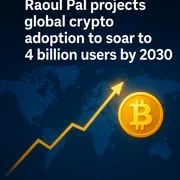
Real Vision CEO and well-known macro investor Raoul Pal has laid out one of the most ambitious forecasts yet for the digital asset industry. Pal believes that the total market capitalization of cryptocurrencies could soar to $100 trillion within the next decade, fueled by explosive user adoption and accelerating institutional participation.
In a recent post on X, the former hedge fund manager drew parallels between the growth trajectory of crypto and the internet. He highlighted adoption data that compared crypto wallet growth to the number of IP addresses as the internet expanded. Pal noted that the crypto ecosystem has grown at an average rate of 137% annually over the past nine years, reaching nearly 659 million users by the end of 2024. By contrast, at a similar stage in its development, the internet had only reached about 187 million users by the year 2000, expanding at a slower 76% annual rate.
Based on these growth patterns, Pal projects that crypto adoption will continue to climb at a rapid—though slightly moderating—pace. He expects the number of crypto users to increase by around 43% in the coming year, with adoption crossing the 1 billion user milestone by 2030. If this forecast holds, it would mean roughly one in eight people on Earth will be engaged with crypto in some form, whether through wallets, decentralized applications, tokenization, or digital assets as part of mainstream finance.
Pal stressed that this kind of user base expansion, coupled with the integration of blockchain into global financial systems, could lay the groundwork for crypto to become a $100 trillion asset class, rivaling traditional markets such as equities and bonds in scale and importance.
Source: Raoul Pal
Pal’s $100 Trillion Market Capitalization Forecast
Raoul Pal, the founder and CEO of Real Vision and Global Macro Investor, has doubled down on one of the most ambitious outlooks for the cryptocurrency sector. According to his latest analysis, the total market capitalization of digital assets could exceed $100 trillion within the next decade, potentially reaching that milestone as early as 2032.
Pal explained that two primary forces would drive such exponential growth: global monetary debasement and widespread adoption of blockchain technology. He argued that monetary debasement—the erosion of purchasing power through inflation and currency dilution—already accounts for the majority of asset price movements. Adoption, on the other hand, explains the relative outperformance of crypto compared to traditional assets. “Debasement explains 90% of price action,” Pal wrote, “while adoption explains 100% of the outperformance versus debasement.”
Community Pushback Against Pal’s Optimism
While Pal’s bullish forecast generated enthusiasm among some in the crypto community, others urged caution. Several commentators on X argued that the underlying metrics used to estimate crypto adoption might be misleading. One user noted that simply counting wallets is not an accurate measure of real growth, since project founders can create thousands of wallets and distribute coins across them to simulate a vibrant community. Another user admitted to creating a new wallet every six months over the past four years, which would artificially inflate user statistics.
Despite the criticism, Pal was quick to defend his methodology, countering that the same issue exists in internet adoption data. Just as individuals often have multiple IP addresses, he argued, crypto users may maintain multiple wallets. This does not, in his view, undermine the broader trend of accelerating adoption.
Adoption Data Supports Long-Term Growth
Supporting Pal’s thesis, data from Triple-A, a B2B digital currency payments platform, estimated that by the end of 2024 there were already more than 560 million global crypto users. Additionally, a report published in October 2024 by Andreessen Horowitz’s crypto division placed the number of “real” active monthly crypto users between 30 million and 60 million, depending on methodology.
These figures, though lower than Pal’s broader projections, still point to a rapidly growing ecosystem. Even if adoption continues at a moderated pace, the trajectory suggests that crypto is becoming an increasingly entrenched part of the global financial landscape. Pal maintains that this combination of macroeconomic forces and expanding adoption could transform cryptocurrencies into a $100 trillion asset class, rivaling traditional markets like equities, bonds, and real estate within the next decade.