
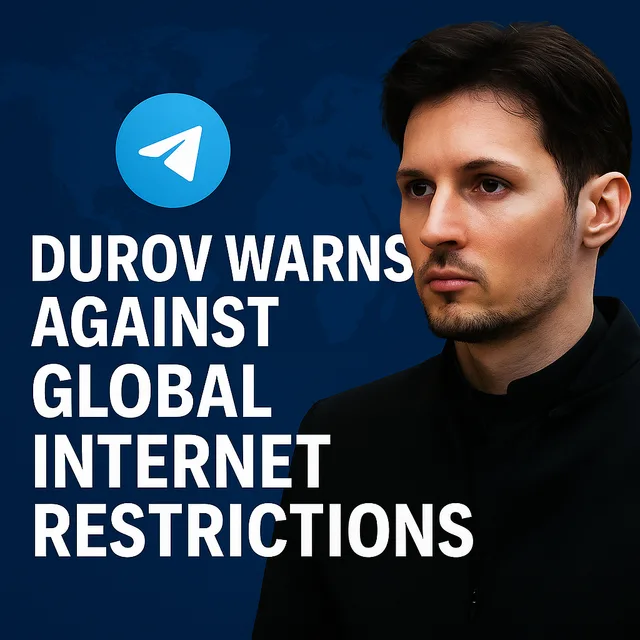
Telegram founder and CEO Pavel Durov has issued a stark warning about the erosion of online freedom, saying that governments around the world are accelerating efforts to impose surveillance and censorship in the name of safety and control.
“I’m turning 41, but I don’t feel like celebrating. Our generation is running out of time to save the free internet built for us by our fathers,” Durov wrote on X (formerly Twitter) on Thursday. “Once-free countries are introducing dystopian measures.”
Related reporting: Self-managed super funds in Australia reduce crypto exposure by 4%.
Durov cited several examples, including the European Union’s “Chat Control” proposal, the United Kingdom’s digital ID program, and Australia’s planned social media age restrictions, all of which he says threaten user privacy and civil liberties.
Source: Pavel Durov
“What was once the promise of the free exchange of information is being turned into the ultimate tool of control,” Durov warned, accusing European governments of criminalizing dissent and punishing those who defend privacy rights. “A dark, dystopian world is approaching fast — while we’re asleep. Our generation risks going down in history as the last one that had freedoms — and allowed them to be taken away.”
Germany pushes back against Chat Control
The EU’s Chat Control legislation, which was scheduled for a vote this month, has become one of the most controversial privacy debates in recent years. The law would require messaging platforms — including Telegram, WhatsApp, and Signal — to scan users’ messages before encryption, effectively breaking end-to-end privacy protections.
However, the measure suffered a major setback this week after Germany’s leading political party publicly opposed it. With Germany holding 97 of the European Parliament’s 720 seats, its opposition could be decisive in blocking the proposal.
Source: Meredith Whittaker
Signal president Meredith Whittaker welcomed the move but warned that “the war is not over,” as the proposal is expected to be revisited by the European Council. “You can’t create a backdoor that only lets the ‘good guys’ in,” Whittaker said. “Such systems would create cybersecurity loopholes that hackers and hostile nations are eager to exploit.”
Digital ID systems spark privacy backlash
In the UK, Prime Minister Keir Starmer announced a digital ID program in September that would require citizens to verify their identity to access essential services like welfare, tax filing, and healthcare. Officials claim the system will help reduce fraud and illegal employment, but privacy advocates argue it risks turning the state into an intrusive data broker.
More than 2.8 million Britons have already signed a petition opposing the plan, warning that it could allow the government to misuse personal data or monitor individuals’ activities. Under UK law, petitions that surpass 100,000 signatures must be considered for debate in Parliament.
Meanwhile, Australia is pursuing its own controversial initiative: a nationwide digital age verification system to restrict social media access for users under 16. The program, which takes effect on December 10, has been criticized for potentially exposing sensitive personal data and setting a dangerous precedent for state surveillance.
The crypto connection: privacy under pressure
Durov’s remarks echo a broader concern across the cryptocurrency and digital privacy communities, where encryption and pseudonymity form the foundation of decentralized technology. Bitcoin, for instance, was designed to eliminate the need for intermediaries and preserve financial privacy — principles increasingly under threat from global regulatory shifts.
As governments introduce policies that expand digital oversight, Durov’s warning serves as a rallying cry for those defending privacy, decentralization, and freedom online.