
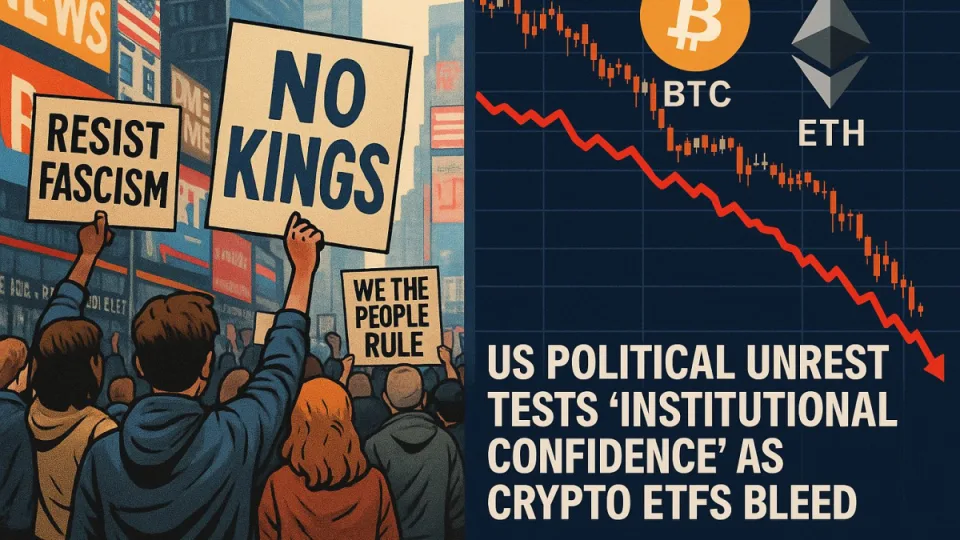
A wave of political unrest and deepening government dysfunction in the United States is testing the confidence of both markets and institutions, as spot Bitcoin and Ethereum ETFs continue to record significant outflows for a fourth straight day.
Data from SoSoValue shows that on Monday, U.S. spot Bitcoin ETFs logged $40.47 million in net outflows, extending a weeklong selloff amid growing risk aversion. BlackRock’s iShares Bitcoin Trust (IBIT) saw the largest withdrawal, shedding $100.65 million, while Fidelity’s FBTC and Bitwise’s BITB offset part of the losses with inflows of $9.67 million and $12.05 million, respectively.
Related reporting: Crypto ETP Inflows Hit $48.7B in 2025, Surpassing 2024 Record as Ether and Altcoins Surge
Despite these mixed flows, the total cumulative inflow across all spot Bitcoin ETFs now stands at $61.5 billion, with total net assets slipping to $149.66 billion — representing roughly 6.76% of Bitcoin’s total market capitalization.
Meanwhile, spot Ethereum ETFs mirrored the bearish sentiment, suffering $145.68 million in daily outflows. BlackRock’s ETHA led with $117.86 million in withdrawals, followed by Fidelity’s FETH, which lost $27.82 million — marking the third consecutive session of red for Ether products.
Spot Bitcoin ETFs see fourth day of outflows. Source: SoSoValue
“No Kings” Protests Add to Market Anxiety
The ETF exodus comes against a backdrop of intensifying political tension across the U.S., as the federal government shutdown enters its 18th day with no resolution in sight.
Nationwide “No Kings” protests erupted over the weekend, with demonstrators accusing the Trump administration of undermining democratic institutions. Marches spanned New York, Washington D.C., Los Angeles, and Portland, where crowds carried placards reading “Resist Fascism” and “We the People Rule.”
In a note shared with Cointelegraph, analysts from Bitunix described the situation as “a stress test of institutional confidence.”
“The political turmoil is not merely a clash between public sentiment and authority — it’s a test of whether the U.S. system can sustain structural trust under extreme pressure,” the analysts said.
They warned that a prolonged shutdown could ripple through markets, tightening liquidity and deepening doubts about America’s ability to govern itself effectively. “The market’s next move may depend on whether the country’s political institutions can restore consensus amid widening division,” they added.
Markets Enter “De-Risking Mode”
According to Vincent Liu, chief investment officer at Kronos Research, the continued ETF outflows are symptomatic of a broader “de-risking phase” sweeping through financial markets.
“Investors are locking in profits and sidelining new capital,” Liu explained. “Risk appetite is shrinking, and both Bitcoin and Ether ETFs are seeing thinner liquidity and reduced bid depth.”
Liu said the combination of political instability and policy uncertainty has amplified the cautionary tone among institutional investors.
“The erosion of trust in U.S. policy stability is pushing capital toward defensive plays,” he said, noting that even traditional risk assets like tech stocks and commodities have seen similar pullbacks.
Still, Liu believes the sentiment could shift if Washington signals a credible fiscal or monetary path forward.
“A more defined macro outlook or a resolution to the political gridlock could quickly restore confidence,” he said. “When that happens, risk appetite will return — and ETF inflows will follow.”