
What does P2P mean?
P2P means peer-to-peer. In networking, computers communicate with other participants rather than every exchange passing through one central application server. Bitcoin nodes relay transactions and blocks over a peer-to-peer network. That networking structure is different from an exchange product called P2P trading.
In a P2P marketplace, people agree to buy or sell crypto with one another. A platform may still control accounts, hold crypto in escrow, set participation rules and mediate disputes. The word peer-to-peer does not establish that the entire service is decentralized.
How does P2P crypto trading work?
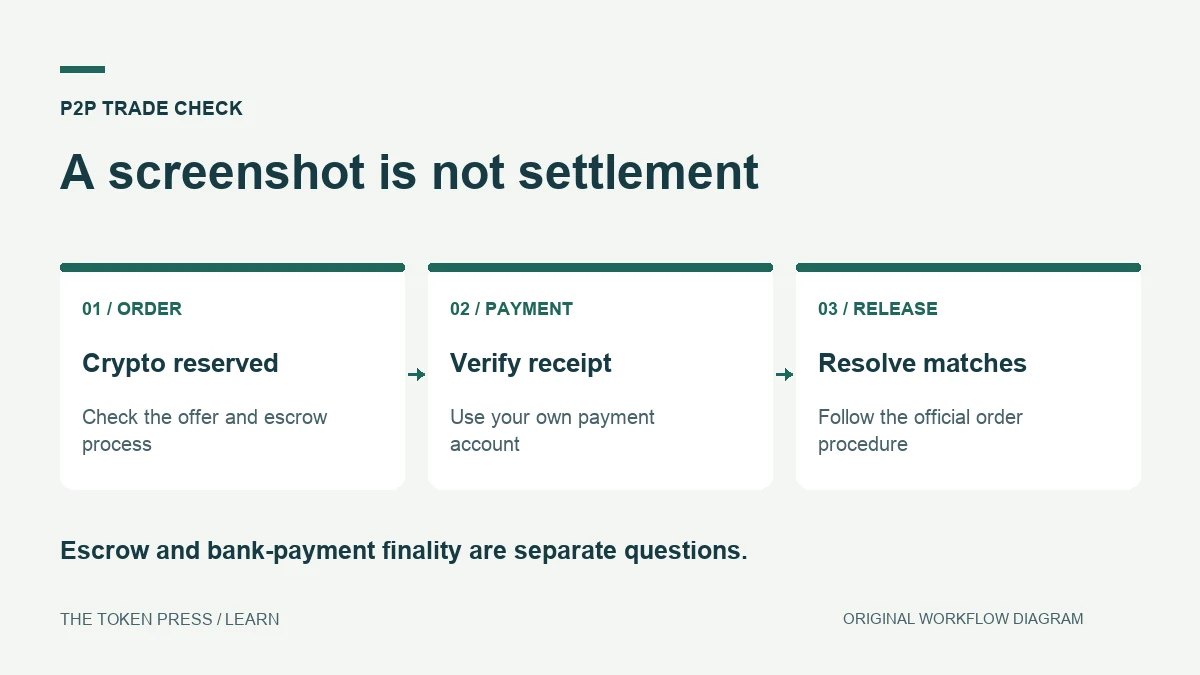
A typical marketplace offer states the asset, price, payment method, size limits and terms. The buyer pays through the agreed method; the platform's crypto escrow and the seller's release process coordinate the other side. The exact sequence and cancellation rules depend on the provider.
Binance's support documentation describes reserving the crypto in escrow when an order is created. It also states that platform fees can vary by market and that payment providers may charge separately. This is a description of one provider's mechanism, not a recommendation or a claim that it is available everywhere.
Before using any service, check local availability, the applicable entity, identity requirements, bank/payment rules and dispute procedure. Do not assume a tutorial written for another country applies to your account.
What does escrow protect, and what does it not prove?
Escrow can keep the crypto reserved while an order is being settled. It does not make a payment screenshot authentic or establish that an off-platform bank transfer is irreversible. Crypto release and bank settlement are separate events.
For example, a seller may see a message saying 'paid' while their own account shows no incoming funds. The message is a claim by another party. It is not equivalent to a verified credit. Do not release crypto because of urgency, a chat message or a purported support instruction outside the official process.
Check the amount, currency, sender details and actual payment state through your own provider. Follow the platform's official dispute process for mismatches or third-party payments. A visible balance can still be subject to the payment rail's reversal or fraud rules.
Compare the total price, not just the advertised rate
Suppose one fictional offer sells 100 units of a dollar-pegged token at ₹90 each with no additional payment charge. The cost is ₹9,000. Another quotes ₹89.50 but adds a ₹100 payment charge, giving ₹9,050. The lower headline rate is more expensive for that transaction.
These numbers are examples, not current exchange rates. Also account for minimum order size, available quantity, network withdrawal fees and any exchange conversion. A token targeting one U.S. dollar is not a guarantee of cash redemption for every holder.
Compare offers for the same asset, amount and payment method. Do not use an unusually attractive price to excuse mismatched account details or requests to move the conversation off-platform.
P2P, spot orders and a DEX are different workflows
A spot exchange order normally matches through an order book. A decentralized exchange commonly executes through smart contracts and an on-chain transaction. A P2P marketplace often connects people settling a fiat payment under an offer's terms. Each has different custody and execution questions.
When reading a tutorial, ask who holds the crypto before the trade, who authorizes its release, where the fiat money travels, and what evidence settles a dispute. Those four questions are more informative than labelling a platform safe because it calls itself P2P.
Practice: should the seller release the crypto?
In a fictional order, the buyer sends a screenshot showing the full amount. Your own payment account has no matching credit. A separate chat account then claims to be support and asks you to release immediately. The correct response is to keep the order within the official platform process and verify the payment independently.
If a credit later appears from a different person's account, that is a new mismatch to resolve under the platform and payment provider's rules. It is not a reason to improvise a refund to an unrelated address. Keep order records and use official support channels.
- Check actual payment receipt through your own account.
- Match the order amount, currency and permitted payer details.
- Keep communication and appeals within the official service.
- Never disclose a recovery phrase or grant remote access to resolve a trade.
- Treat screenshots and urgency as claims to verify, not release authority.
Sources & further reading
- Bitcoin developer guide: the peer-to-peer network
- Binance: P2P marketplace, escrow and fees
- Binance: proof-of-payment scams
Educational content. Examples are illustrative. Protocols, products and rules can change; consult the linked documentation for current details.