
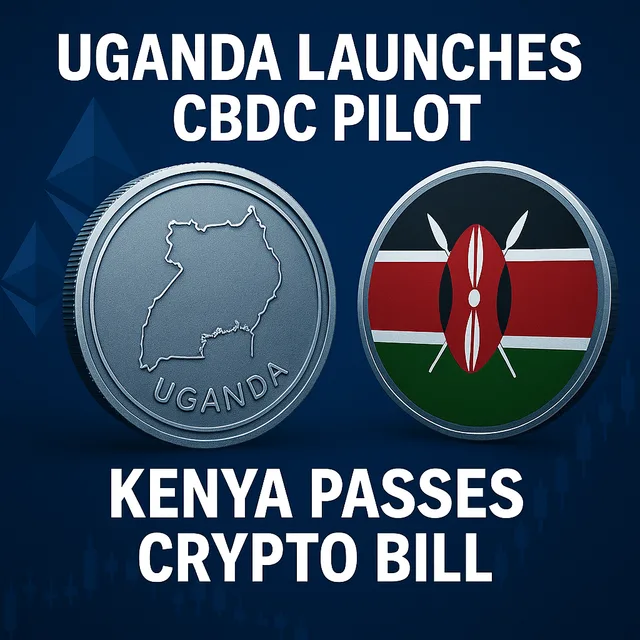
Uganda has officially launched a central bank digital currency (CBDC) pilot — a digital version of the Ugandan shilling — marking a major milestone in East Africa’s growing blockchain adoption. The move comes just as neighboring Kenya edges closer to becoming one of the first African nations to implement a comprehensive legal framework for cryptocurrencies.
The pilot forms part of a $5.5 billion tokenization initiative led by the Global Settlement Network (GSN) in collaboration with Ugandan developer Diacente Group, announced on Wednesday. The partnership aims to digitize key national assets while integrating blockchain technology into Uganda’s broader financial infrastructure.
Related reporting: Crypto Stocks IREN and NAKA Slide as Convertible Note Deals Spark Dilution Concerns
According to the announcement, Uganda’s CBDC is issued on GSN’s permissioned blockchain, fully backed by Ugandan treasury bonds, and accessible to citizens via mobile devices. The system includes built-in Know Your Customer (KYC) and Anti-Money Laundering (AML) protocols, ensuring compliance with both local and international regulatory standards.
“By integrating tokenization and CBDCs into Uganda’s development roadmap, we’re creating transparent, tech-driven ecosystems that attract new capital, empower local industries, and scale sustainable growth from the ground up,”
said Edgar Agaba, chairman of Diacente Group.
The pilot’s tokenization phase will focus on digitizing sectors that are vital to Uganda’s economy — including agriculture, mining, and renewable energy infrastructure, such as solar power projects and agro-processing hubs.
The initiative makes Uganda one of the most progressive African countries in the region when it comes to digital currency innovation. It follows Nigeria, which became the continent’s first to roll out a CBDC in 2021, and joins Ghana, South Africa, and Egypt, which are all at varying stages of development or research.
Kenya’s VASP bill passed through the country’s parliament on Tuesday. Source: YouTube
A report from Chainalysis in September identified Sub-Saharan Africa as the third-fastest-growing crypto region globally, with $205 billion in on-chain value recorded between July 2024 and June 2025 — signaling the continent’s rising role in the global crypto economy.
Kenya’s Crypto Bill Passes Final Parliamentary Hurdle
Across the border, Kenya is also making significant strides in crypto regulation. On Tuesday, the country’s Virtual Asset Service Providers (VASP) Bill passed its third reading in Parliament, clearing the final legislative step before it can be signed into law by President William Ruto.
The legislation introduces licensing requirements, consumer protection standards, and regulatory oversight for crypto exchanges, brokers, wallet providers, and token issuers. Under the framework, the Central Bank of Kenya will regulate payments and custody services, while the Capital Markets Authority (CMA) will oversee trading and investment-related activities.
Several African countries have already piloted CBDCs, while others are still in the research phase. Source: ODI Global
The bill includes comprehensive KYC/AML obligations aligned with the Financial Action Task Force (FATF) and provisions against misleading advertising. It also introduces fines and penalties for non-compliance, providing legal clarity for Kenya’s rapidly growing crypto sector.
Africa’s Crypto Future: Rising Users and Stablecoin Growth
Africa’s digital asset market is expanding at a remarkable pace. According to Statista, over 75 million Africans are expected to own or use crypto by 2026, representing nearly 6% of the continent’s population, with total market revenues projected to exceed $5.1 billion.
Stablecoins play a crucial role in the region’s adoption story — 43% of Sub-Saharan Africa’s crypto transaction volume is attributed to stablecoins, according to Chainalysis. Nigeria, South Africa, Ghana, Kenya, and Zambia dominate usage, while Uganda ranks seventh.
The combination of Uganda’s CBDC pilot and Kenya’s imminent regulatory framework underscores a clear shift across Africa — one where governments are no longer on the sidelines but are actively shaping the next chapter of digital finance.