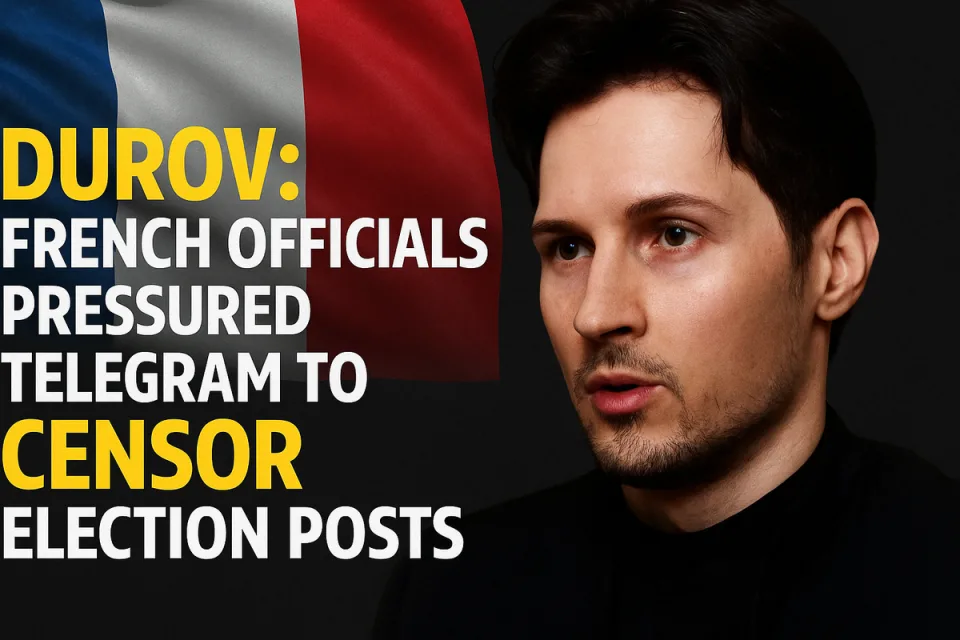
Telegram co-founder Pavel Durov has accused French intelligence services of pressuring the platform to censor political content related to Moldova’s 2024 election in exchange for leniency in his ongoing legal case.
In a Sunday Telegram post, Durov said the platform complied initially by removing content that “clearly” violated its terms of service. However, when authorities later provided a second list of “problematic” channels, nearly all of which he said were legitimate and compliant, he refused to take them down.
Their only commonality was that they voiced political positions disliked by the French and Moldovan governments. We refused to act on this request,” Durov wrote.
Source: Pavel Durov
The claims add to ongoing tensions between Durov and European governments. Following his arrest in France in August 2024, which drew widespread condemnation from the crypto community and human rights groups, Durov has positioned himself as a vocal critic of state-led censorship efforts.
European Pressure on Political Content
This is not the first time Durov has accused French and European authorities of seeking political censorship on Telegram. In May 2025, he said French intelligence had previously pressed him to remove content tied to Romanian elections, which he also rejected.
“You can’t ‘defend democracy’ by destroying democracy. You can’t ‘fight election interference’ by interfering with elections. You either have freedom of speech and fair elections — or you don’t,” he said at the time.
He has also warned that Telegram will exit jurisdictions, including France, rather than compromise user privacy by sharing encryption keys or building surveillance backdoors.
Free Speech Battle Escalates in Europe
Durov has repeatedly accused France and the EU of accelerating a crackdown on online freedoms. In June, he said France was “inching toward societal collapse” due to censorship and failed state policies. His concerns grew louder in 2025 as the EU advanced a controversial proposal to monitor all chat messages — including encrypted communications — with support from 19 member states.
The dispute underscores a larger battle between governments seeking to regulate political speech online and tech platforms defending user privacy and free expression. For Telegram, which serves hundreds of millions of users worldwide, the confrontation has become both a legal and ideological fight.