
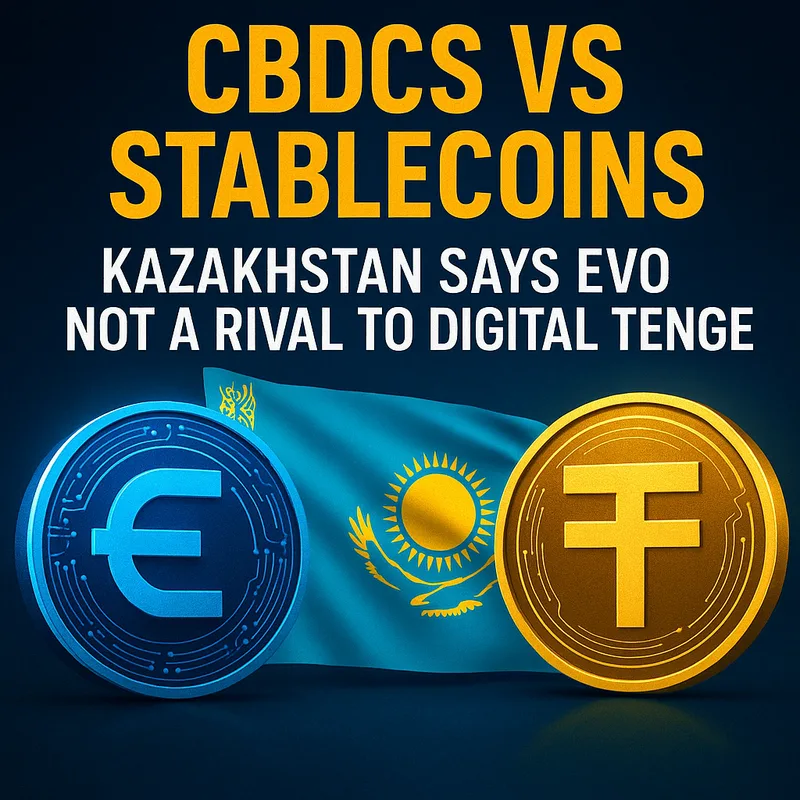
Kazakhstan is taking a distinctive approach to digital assets, rolling out both a central bank digital currency (CBDC) and a state-linked stablecoin, framing them as complementary tools rather than competitors.
In September, the National Bank of Kazakhstan (NBK) launched the Evo stablecoin in collaboration with Solana and Mastercard, marking one of the world’s first government-backed stablecoin initiatives. This comes alongside the country’s ongoing pilot of the digital tenge, which began circulating in limited trials in 2023.
Related reporting: OpenAI Hits $500B Valuation, Overtaking SpaceX and Leaving Crypto Giants in the Dust
Berik Sholpankulov, deputy governor of the NBK, told Cointelegraph that the digital tenge and Evo should be seen as interoperable solutions within a broader financial strategy. “When discussing the Evo stablecoin and the digital tenge, we see not competition, but rather opportunities for integration,” he said. Lawmakers are currently working to give the CBDC full legal tender status, placing it on equal footing with fiat currency.
CBDC for Interbank Settlement, Stablecoin for Ecosystems
Sholpankulov stressed that Evo, like other privately issued stablecoins, is designed to operate within specific ecosystems. Its usage will scale with the number of participating businesses and users.
By contrast, the digital tenge will be state-issued and legally recognized as money, expected to become integral to interbank settlement and monetary policy. “Once the regulatory framework is fully in place, the digital tenge will serve as a guarantor on behalf of the national bank and as a foundation for fintech solutions,” Sholpankulov explained.
Berik Sholpankulov, deputy governor of the National Bank of Kazakhstan, during a policy briefing on digital asset regulation, May 2025. Source: YouTube
Talgat Dossanov, founder of Intebix exchange — which issues Evo with Eurasian Bank — echoed these sentiments. He described the two instruments as forming a “two-tier system”: the CBDC reinforcing Kazakhstan’s financial sovereignty, while Evo accelerates global crypto integration and enables cross-border payments.
A Bid to Become Central Asia’s Crypto Hub
The dual-track strategy aligns with Kazakhstan’s ambition to position itself as the crypto capital of Central Asia.
CBDCs versus stablecoins. Source: B2BinPay
The country has already piloted paying regulatory fees in stablecoins, launched one of the region’s first spot Bitcoin funds, and is working on a state-backed crypto reserve. Its government has also nurtured close ties with global players: Binance, which won approval for a crypto fund with BNB exposure in September, and Telegram co-founder Pavel Durov, who announced an AI research lab in Astana during the Digital Bridge 2025 forum.
Former Binance CEO Changpeng “CZ” Zhao also met with National Bank chairman Timur Suleimenov this week to discuss launching a new KZTx stablecoin, tokenization initiatives, and blockchain innovation projects in Alatau City.
Dossanov contrasted Kazakhstan’s strategy with the Trump administration’s decision to block CBDCs in favor of stablecoins, arguing that emerging economies still view CBDCs as crucial to ensuring financial sovereignty and reducing reliance on foreign-backed tokens.
“For Kazakhstan, the main objective of the digital tenge is securing independence and sovereignty of the national payment infrastructure,” Sholpankulov emphasized.