
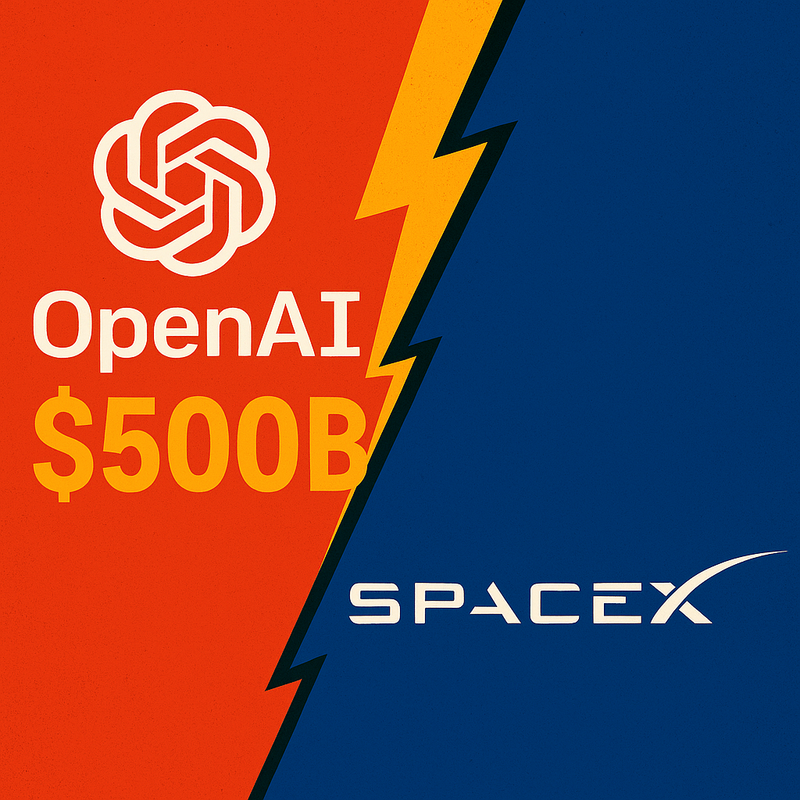
Artificial intelligence powerhouse OpenAI has cemented its position as the world’s largest startup, achieving a staggering $500 billion valuation after a secondary share sale that highlights both investor enthusiasm for AI and the increasing overlap with blockchain technology.
Source: Paolo Ardoino
Earlier coverage: Stablecoin Duopoly Under Pressure as USDT and USDC Market Share Slips to 84%
$6.6 Billion Secondary Share Sale Fuels Record Valuation
According to a Bloomberg report citing anonymous sources, current and former OpenAI employees sold $6.6 billion worth of stock to investors including Thrive Capital, SoftBank Group Corp., Dragoneer Investment Group, Abu Dhabi’s MGX, and T. Rowe Price.
The share sale propelled OpenAI’s valuation to half a trillion dollars, overtaking Elon Musk’s SpaceX (valued at around $400 billion) and dwarfing other major startups like ByteDance ($220 billion) and Anthropic ($183 billion).
This milestone underscores how artificial intelligence has become a dominant force in global capital markets, with investors viewing AI—and blockchain—as foundational pillars of the next wave of digital infrastructure.
Crypto Firms Still Trail Behind
OpenAI’s valuation places it far ahead of the crypto industry’s largest players. Publicly traded exchange Coinbase currently sits at an $89 billion market cap, while industry leaders such as Ripple, Circle, and Binance have yet to cross the $100 billion threshold.
Stablecoin giant Tether is the only crypto company seen as potentially rivaling OpenAI’s scale. Artemis CEO Jon Ma previously claimed that if Tether were to go public, its valuation could hit $515 billion, ranking it among the world’s top 20 companies.
Tether CEO Paolo Ardoino acknowledged the estimate but called it “a bit bearish,” pointing to the firm’s massive Bitcoin and gold reserves as justification for an even higher implied valuation. He also stressed that Tether has “no need” to go public.
AI Agents and Stablecoins: A Growing Convergence
As AI and blockchain continue to evolve, their interconnection is becoming more pronounced. Galaxy Digital CEO Mike Novogratz recently predicted that AI agents will be the largest users of stablecoins, citing their ability to facilitate instant, automated, and borderless transactions.
Evidence of this trend is already emerging. A recent CEX.io Research report found that more than 70% of stablecoin transactions in Q3 2025 were linked to bot activity—indicating early adoption by automated systems and AI-driven agents.
Galaxy itself has been ramping up its AI efforts, securing a $1.4 billion loan in August to accelerate development of its Texas Helios AI datacenter. The facility is projected to generate over $1 billion annually, supporting AI and high-performance computing operations for CoreWeave.
Energy Demands Raise Alarms
However, AI’s rapid expansion is also raising concerns. Greg Osuri, founder of decentralized cloud provider Akash, warned at Token2049 Singapore that the energy demands of AI training models may soon overwhelm existing grids, potentially requiring nuclear power to sustain growth.
Osuri argued for alternative solutions, such as decentralized AI training systems, which could help distribute computational load and reduce reliance on energy-intensive centralized models.