
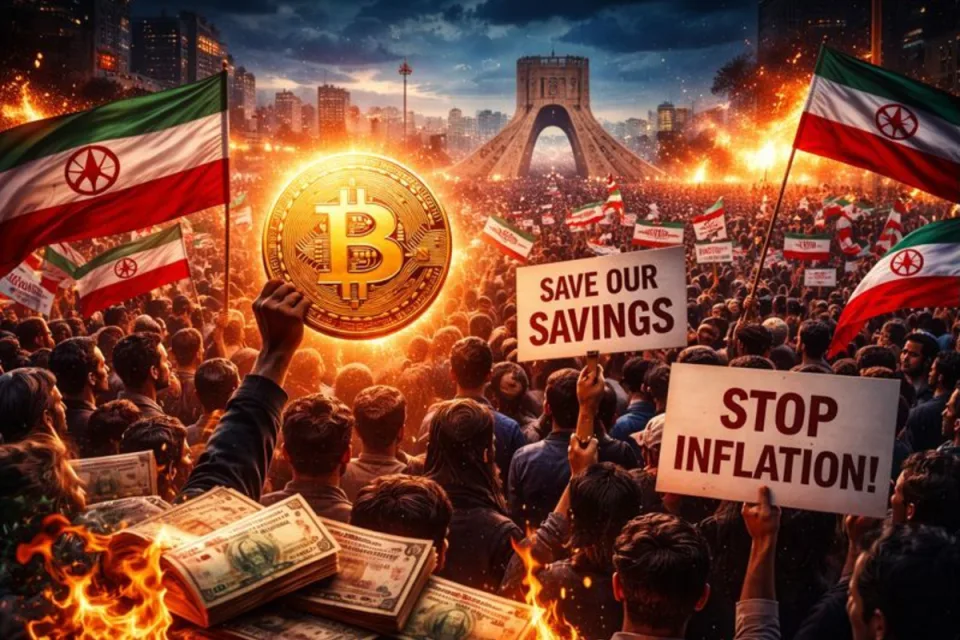
Widespread protests in Tehran this week have drawn renewed attention to Iran’s deepening currency crisis, after the rial slid to fresh record lows against the US dollar. As Iranians took to the streets to protest the erosion of their savings, the episode has reignited debate within the crypto industry about Bitcoin’s role as a hedge against economic mismanagement and monetary instability.
The demonstrations followed a sharp decline in the rial’s purchasing power, which locals largely attribute to years of fiscal missteps, sanctions pressure, and dwindling confidence in Iran’s banking system. Against that backdrop, Bitwise CEO Hunter Horsley argued that Bitcoin offers an alternative store of value for people living under failing monetary regimes.
Related reporting: Crypto ETP outflows deepen over holidays as investors stay selective into year-end
Posting on X, Horsley said Bitcoin provides a new way for individuals to protect themselves when governments debase their currencies, calling economic mismanagement a recurring theme across history rather than a uniquely Iranian problem.
Rial’s rapid decline fuels public anger
Iran’s currency has weakened dramatically in recent months. According to the Financial Times, the rial has lost more than 40% of its purchasing power since a two-week conflict with Israel in June. The exchange rate has now reached roughly 1.4 million rials per US dollar, an unprecedented low.
For context, Alex Gladstein, chief strategy officer at the Human Rights Foundation, noted that in the early 1980s the official exchange rate stood at just 70 rials per dollar. The contrast underscores the scale of Iran’s long-term monetary deterioration.
Public frustration has been amplified by political instability. Mohammad Reza Farzin, the governor of the Central Bank of Iran, resigned amid the protests, deepening uncertainty about whether meaningful reforms are forthcoming. For many Iranians, the loss of confidence in financial institutions has translated directly into pressure on the streets.
Crypto adoption constrained by regulation
While cryptocurrencies are not banned outright in Iran, the regulatory environment remains restrictive. Trading is permitted, but rules around self-custody are opaque, and Bitcoin mining is tightly controlled.
VanEck head of research Matthew Sigel pointed out that Iranian authorities have actively discouraged grassroots participation in Bitcoin mining, despite the country’s exceptionally low electricity costs. In recent years, the
government has cracked down on unregistered miners and even offered financial incentives for citizens to report illegal operations.
This approach has prevented many Iranians from taking advantage of conditions that could allow Bitcoin to be mined for as little as $1,300 per coin — a fraction of its current market price. Critics argue that the policy timing is particularly damaging, as demand for alternative stores of value rises precisely when access is being curtailed.
Banking sector stress adds to pressure
Iran’s financial system is also showing signs of strain. Long-standing international sanctions tied to Tehran’s nuclear program and regional activities have limited access to global financial networks, weakening domestic banks and cutting off dollar liquidity.
In October, state-owned Bank Melli reportedly collapsed, placing the assets of more than 42 million Iranians at risk. Earlier this year, Iran’s central bank warned that eight additional banks could face dissolution unless they implement structural reforms, raising concerns about broader systemic instability.
The challenges extend into the crypto sector itself. In June, Iranian exchange Nobitex suffered an $81 million hack, further eroding trust. Onchain data shows crypto flows linked to Iran fell 11% in the weeks following the incident, coinciding with renewed regional tensions.
Bitcoin as a global hedge, not a cure
Industry figures caution that Bitcoin is not a silver bullet for Iran’s economic challenges, which are rooted in geopolitics, governance, and sanctions. However, supporters argue that it can offer individuals an escape valve when local currencies fail and access to the global financial system is restricted.
The events in Iran mirror similar episodes in countries facing chronic inflation and capital controls, reinforcing Bitcoin’s narrative as a tool for financial self-preservation rather than speculation. As protests continue and the rial remains under pressure, the debate over Bitcoin’s real-world utility is once again moving from theory into lived experience.
