
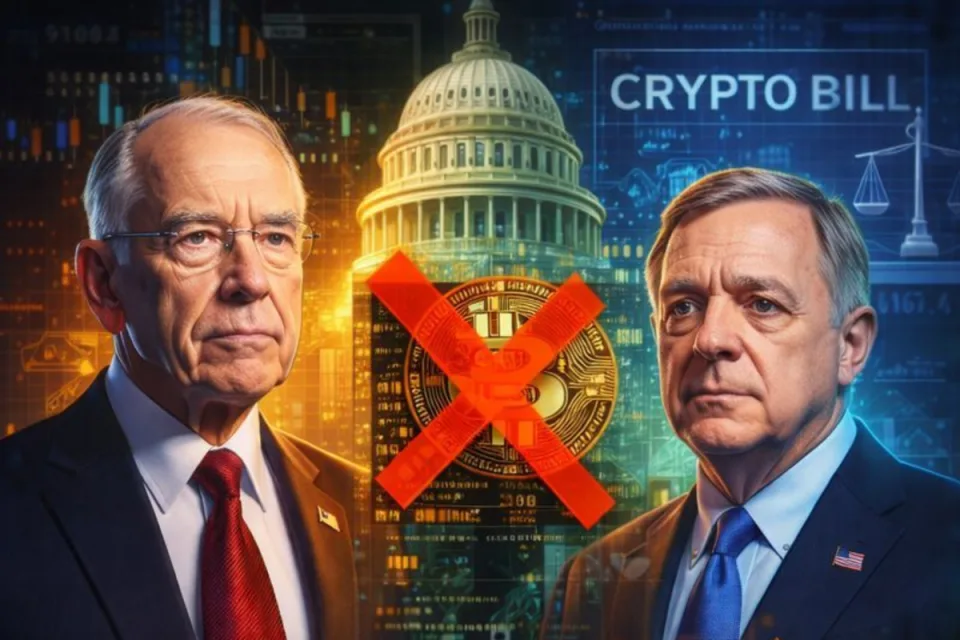
Senior lawmakers on the US Senate Judiciary Committee are urging colleagues to remove developer protections from a sweeping crypto market structure bill, warning that the provisions could undermine the government’s ability to enforce money transmission laws and combat illicit finance.
In a letter sent Wednesday, Senate Judiciary Committee Chair Charles Grassley and the panel’s top Democrat, Richard Durbin, asked Senate Banking Committee leaders Tim Scott and Elizabeth Warren to reconsider language they say would create enforcement blind spots for decentralized platforms.
The senators argued that, as written, the bill could “create a significant enforcement gap for decentralized digital asset platforms,” potentially making it harder for authorities to pursue unlicensed money transmitters. The concerns were first reported by Politico.
Warnings over enforcement gaps and illicit activity
Grassley and Durbin said the proposed changes risk weakening long-standing laws used to police financial crimes, including those involving unlicensed money transmission. In their view, narrowing liability around software developers and network operators could inadvertently shield bad actors.
“Such a gap risks attracting illicit actors — like cartels and other sophisticated criminal organizations — to decentralized platforms,” the lawmakers wrote, adding that criminals already rely on techniques to obscure illegal transactions. They warned the bill could further complicate prosecutions if safeguards are loosened.
The pushback centers on language drawn from the Blockchain Regulatory Certainty Act, which aims to clarify that writing software or maintaining decentralized networks does not, by itself, make developers subject to federal or state money transmission requirements.
Judiciary Committee says it was sidelined
The Judiciary Committee, which oversees federal criminal law and the Justice Department, said it was not consulted during the drafting process. Grassley and Durbin wrote that the panel “was not consulted or given the opportunity to meaningfully review the proposed changes in advance.”
They urged the Banking Committee to reject any language that could “weaken the government’s ability to hold culpable actors accountable for operating unlicensed money transmitting businesses,” underscoring a growing divide in Congress over how far crypto-specific exemptions should go.
Legislative path remains uncertain
The dispute adds another obstacle for the Senate’s crypto market structure effort. Both the Banking and Agriculture Committees have already delayed planned markups as leaders seek broader bipartisan support.
If the bill advances out of committee, it would still face a high bar on the Senate floor, where 60 votes are required for passage. That threshold would likely demand near-unanimous Republican backing and support from several Democrats.
Industry pressure has also intensified. Coinbase, one of the sector’s most influential lobbyists, withdrew its support for the bill earlier this week, citing concerns with multiple provisions, though the company said discussions with lawmakers are continuing.