
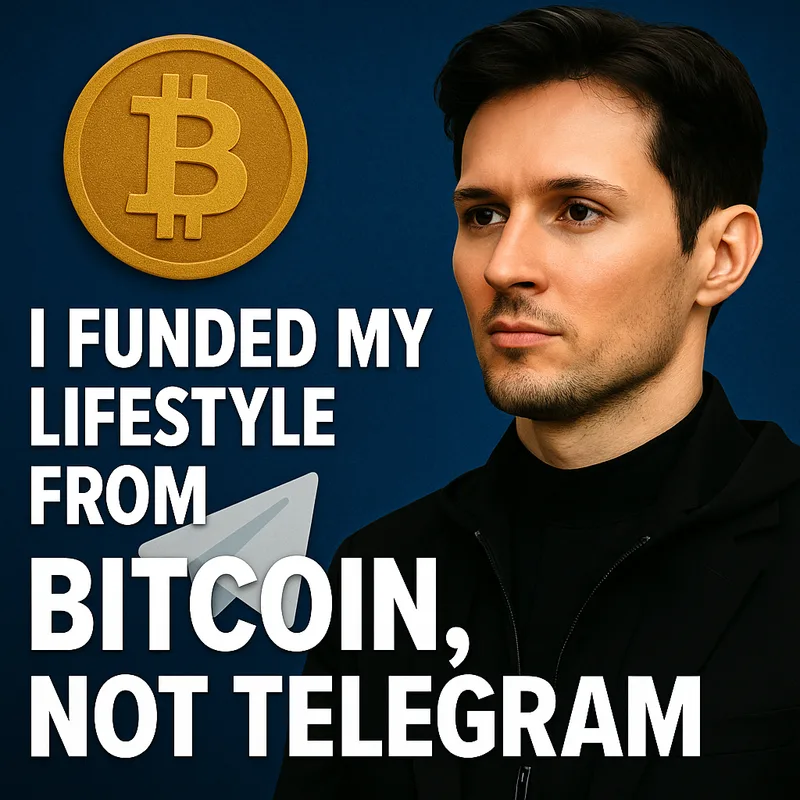
Telegram founder and CEO Pavel Durov has revealed that his early Bitcoin investment — not revenue from his popular messaging app — has been the key to supporting his personal lifestyle.
Speaking on the Lex Fridman Podcast, Durov explained that he first bought Bitcoin in 2013 when the cryptocurrency was trading around $700. “I was a big believer in Bitcoin since more or less the start of it. I got to buy my first few thousand Bitcoin in 2013, and I didn’t care much,” he said. “I just threw a couple of million there.”
Related reporting: Coinbase Exec: AI Agents Will Rely on Crypto, Not Legacy Finance
Although the investment came at what turned out to be a local peak, followed by a steep decline to below $200 during the 2014–2015 bear market, Durov said he remained unfazed. “Some people laughed at me when it dropped, but I told them, ‘I don’t care. I’m not going to sell it. I believe in this thing.’”
Pavel Durov talks Bitcoin to Lex Friedman. Source: YouTube
He emphasized Bitcoin’s unique qualities, particularly its resistance to censorship and confiscation: “Nobody can take your Bitcoin away for political reasons.”
Bitcoin helped Durov “stay afloat”
Addressing speculation that his wealth comes from Telegram, Durov clarified that the messaging platform has been a financial drain for him personally.
“Some people think if I’m able to rent nice locations or fly private, it’s because I somehow extract money from Telegram,” he said. “Telegram is a money-losing operation for me. Bitcoin is what allowed me to stay afloat.”
Durov also predicted that Bitcoin will eventually reach $1 million per coin, citing the constant money printing by governments worldwide. “Nobody’s printing Bitcoin. Its inflation is predictable, and at some point it stops. Bitcoin is here to stay. Fiat currencies — we’ll see.”
Durov on TON and blockchain
The discussion also touched on Telegram’s blockchain ambitions. Durov recalled the company’s work on the Telegram Open Network (TON), which was initially developed to handle the platform’s massive user base but was halted by U.S. regulatory pressure.
He explained that Bitcoin and Ethereum were “not scalable enough” for hundreds of millions of Telegram users, which led to TON’s design around shardchains for better scalability. Although Telegram stepped back, the network has since evolved into The Open Network (TON), deeply integrated into Telegram’s ecosystem.
“TON has become, I think, the largest or second largest blockchain in terms of daily NFT trading volumes,” Durov noted.
TON’s native token, Toncoin (TON), reached an all-time high of $8.25 in 2024 but has since fallen over 67%, reflecting broader market volatility.