
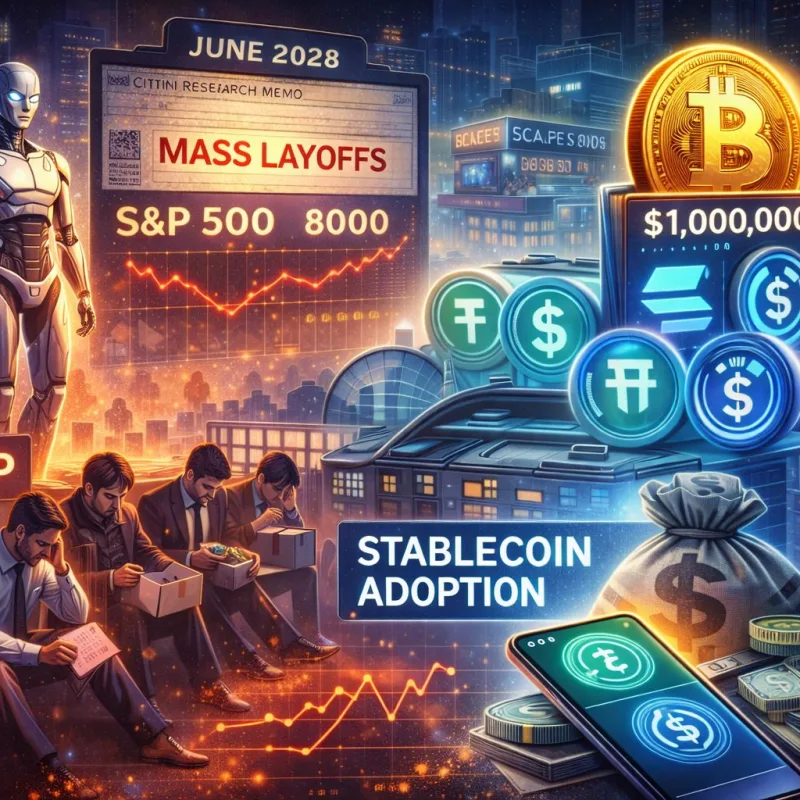
A viral 2028 scenario imagines AI supercharging profits while eroding consumer demand
Citrini Research has published a fictional macro memo dated June 2028 that paints a striking picture of an economy reshaped by artificial intelligence. Framed as a future retrospective, the scenario envisions AI finally delivering on long-promised productivity gains — but at a profound social cost.
In the imagined 2028, corporations slash headcount as automation replaces white-collar roles. Profit margins expand and equity markets initially surge. The S&P 500 “flirts with 8000,” while the Nasdaq breaks above 30,000, fueled by investor enthusiasm for a new efficiency era.
Related reporting: Fed’s Kashkari calls crypto “useless,” dismisses stablecoin pitch as “word salad”
Yet beneath the rally, the foundation begins to crack. As displaced workers curtail spending, consumer demand weakens. Companies respond by doubling down on automation to protect margins, triggering further layoffs.
What starts as a productivity boom morphs into a self-reinforcing contraction in human income and consumption.
The result, Citrini suggests, is an economy that grows on paper but hollows out in practice.
Ghost GDP and the fragility of demand
In the fictional memo, the top 10% of earners account for more than half of consumer spending. Mid-level knowledge workers — product managers, analysts, consultants — are replaced by software agents once capable of performing similar tasks at scale.
Citrini describes the outcome as “ghost GDP”: productivity metrics and corporate earnings soar, yet wage growth deteriorates. Restaurants, retail and other service sectors quietly struggle in an economy where output expands without distributing income broadly.
Housing becomes the tipping point. Roughly $13 trillion in US mortgages rest on the assumption of stable employment. Unlike the subprime crisis of 2008, loans in this scenario were sound at origination. The shock comes from rising joblessness, which climbs above 10%, triggering a sharp equity drawdown of 40% to 60% from peak levels.
Even then, markets appear less reactive than in past crises. Machine-driven liquidity and algorithmic capital flows dampen volatility, masking the underlying strain in household balance sheets.
Stablecoins and crypto rails power AI-native payments
For crypto observers, the most consequential part of Citrini’s scenario lies in payments.
Autonomous AI agents, the memo argues, optimize for cost, speed and programmability. They are indifferent to brand loyalty or legacy infrastructure. In that environment, high interchange fees and geographic frictions
associated with traditional card networks become inefficient.
Instead, AI systems route transactions through stablecoins settled on high-throughput, low-cost blockchains such as Ethereum and Solana. As labor expenses shrink and digital commerce expands, value accrues to the owners of compute infrastructure and digital settlement rails.
The shift, in this narrative, undermines the economics of card networks reliant on 2%–3% fees. Stablecoins become a default settlement layer for machine-to-machine transactions, quietly expanding their role in global payments.
Agentic commerce changes payment rails. Source: Citrini Research
Wealth concentrates as asset ownership outpaces labor
The scenario also amplifies concerns around inequality. Bitwise adviser Jeff Park summarized the tension succinctly: as AI reduces the value of labor, asset ownership becomes more powerful.
In the memo’s imagined 2028, wealth inequality widens to unprecedented levels. Owners of capital — equities, compute infrastructure, digital assets — thrive, while displaced workers struggle to re-anchor their income. Bitcoin, in this speculative arc, breaks above $1 million as investors seek hard assets in a world of aggressive monetary responses and structural labor displacement.
The most unsettling detail is not the projection itself but its framing. Though dated 2028, the post was written in early 2026. Layoffs tied to automation are already rising. Stablecoin usage is expanding. And AI adoption continues to accelerate across sectors.
Whether the future unfolds as Citrini describes remains uncertain. But the memo crystallizes a debate already underway: can AI-driven productivity gains sustain growth if they erode the very consumers who power the economy?